Turning Your Yacht Survey Into a Clear, Workable Plan
A thorough marine survey is one of the most valuable documents a yacht owner will ever receive—especially at purchase. But for many new owners, that 40–80 page report quickly becomes a source of stress: a dense punch list of comments, codes, and recommendations with no clear roadmap.
The real value of a survey comes when it’s converted into an organized, prioritized plan of action. That’s where professional yacht management and an owner’s representative make the difference between “I have a binder of issues” and “I have a vessel that’s improving every month.”
This guide walks through how to:
- Triage survey findings by risk
- Convert recommendations into concrete tasks with vendors
- Track progress and verify closure
- Preserve records that help you and future buyers
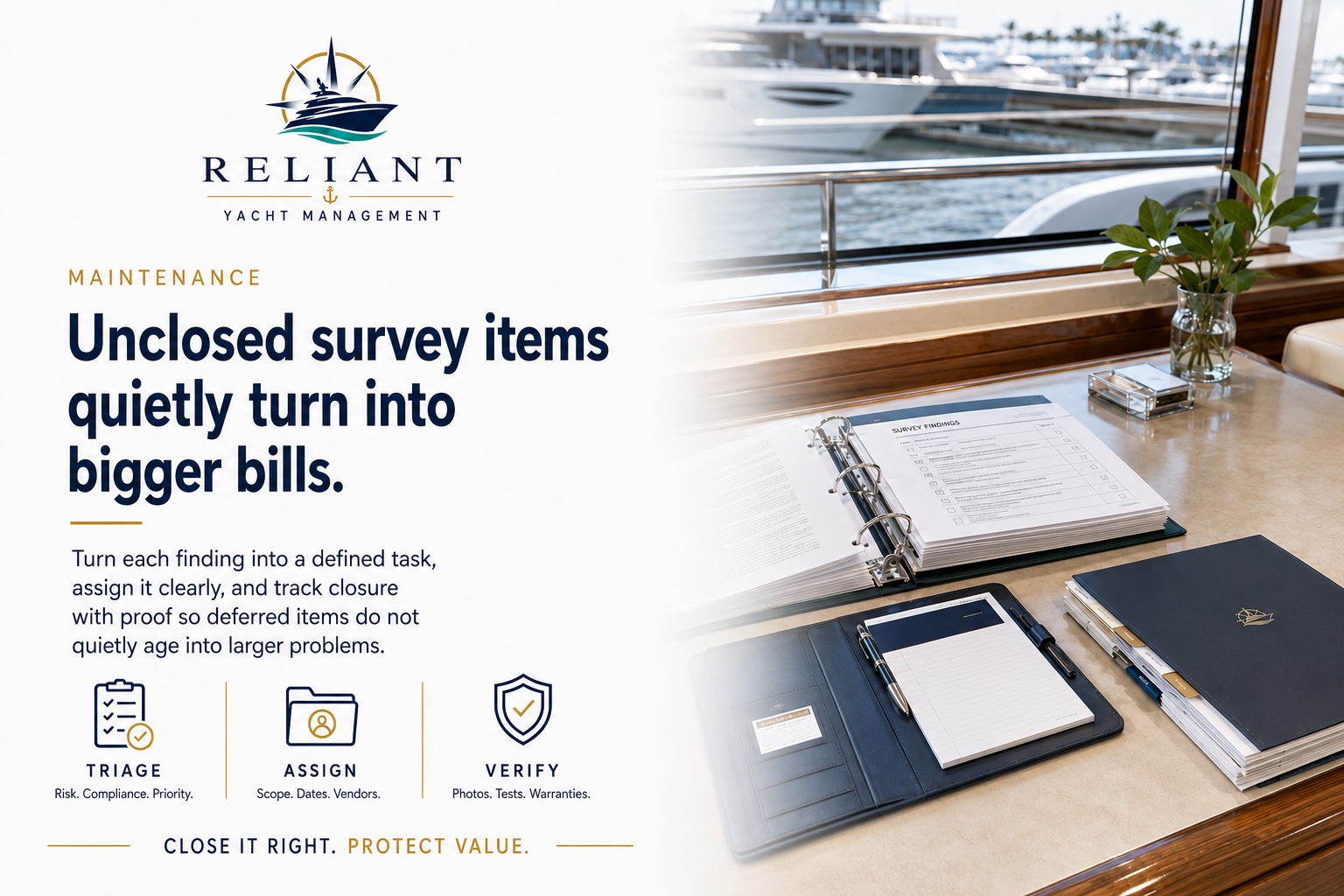
- Prevent small issues from quietly aging into major projects
Step 1: Triage Your Survey by Risk, Not by Page Order
Surveys often blend critical safety items with cosmetic notes. Reading front-to-back can make everything feel equally urgent. Instead, reframe the report into four practical categories:
1. Safety-Critical / Insurance-Critical (Address Immediately)
Anything that affects seaworthiness, safety, or insurance compliance belongs here, such as:
- Fuel system leaks or non-compliant hoses
- Defective seacocks, through-hulls, or hose clamps below the waterline
- Steering or control issues
- Fire suppression, extinguishers, or alarms out of spec
- Significant electrical hazards, exposed wiring, or overfusing
These are “no-go” items. They may prevent coverage, a closing, or safe operation.
2. Mission-Critical Reliability (Next 30–90 Days)
These don’t always keep you from leaving the dock tomorrow, but they threaten dependability:
- Early signs of shaft seal wear or misalignment
- Batteries at end of life, questionable charging systems
- Cooling system concerns, oil weeps, minor fuel seepage
- Windlass, thrusters, or navigation systems with intermittent faults
If you plan to cruise, these items belong at the top of your first maintenance plan.
3. Preventive / Deterioration Control (Plan This Season)
Left alone, these become bigger and more expensive:
- Minor deck leaks, early core moisture, or bedding failure
- Rust on engine mounts, surface corrosion on hardware
- Early gelcoat cracking, minor blistering, cosmetic teak issues
- Aging hoses and clamps that are “serviceable but near end of life”
These are the classic “it was just a stain last year” problems. They require scheduling and monitoring, not panic.
4. Cosmetic & Preference (Plan by Budget and Desire)
These affect enjoyment and resale perception, not core safety:
- Upholstery, soft goods, and interior finishes
- Non-structural cabinetry, lights, or trim
- Electronics upgrades for convenience rather than necessity
Collect them, price them, and align them to your comfort and budget.
A professional owner’s representative will reformat your survey into this kind of risk-based matrix, so you’re not guessing what matters most.
Step 2: Convert Survey Comments Into Actionable Tasks
Survey language is written for objectivity and liability, not for project management. Phrases like “Recommend further evaluation” or “Suggest replacement” must be translated into specific, trackable tasks.
For each item, you want to define:
-
What exactly is the issue?
“Stiff seacock at port head sink; appears original; service or replacement recommended.” -
What outcome is desired?
“Seacock must operate smoothly, be ABYC-compliant, and be documented as serviced or replaced.” -
Who is responsible?
- Owner’s representative to scope work and select vendor
- Specific yard, mechanic, electrician, or specialist to perform work
-
What is the status and timing?
- Evaluate
- Quote
- Approve
- Schedule
- In progress
- Completed / verified
Your owner’s rep becomes the bridge between the surveyor’s language and the vendors’ work orders. Reliant, for example, takes each survey recommendation and enters it as an individual, documented action item tied to a system (hull, electrical, fuel, etc.), a responsible party, and a timeline.
Step 3: Coordinate Vendors and Verify Repairs—Don’t Just Approve Invoices
For new owners, a common trap is assuming “the yard is handling it” equals “the problem is fully resolved.” Effective survey follow-up requires:
-
Scoping before authorizing
- Is this a simple service, or does it warrant a second opinion?
- Is the recommended remedy proportional to the risk and your use case?
-
Getting clear, written estimates
- What’s included? What’s excluded?
- Are there likely change orders if hidden damage appears?
-
On-site oversight where it matters
- Confirm that the actual work matches the scope (components replaced, wiring run correctly, seacocks labeled and accessible).
-
Verification and documentation
- Photos of before/after
- Serial numbers for major equipment
- Notes of test procedures and results (e.g., “Generator load-tested to X% for Y minutes”)
Reliable vendors are essential, but they work best when someone is aligning their efforts with your bigger plan and checking details on your behalf.
Step 4: Track Closures So Nothing Quietly Ages Out
Survey items that aren’t addressed immediately shouldn’t vanish into a file folder. They need to move into an ongoing maintenance and monitoring plan.
A strong tracking system will show, at a glance:
- All open survey items, categorized by risk
- What’s been completed, when, and by whom
- Items postponed intentionally, with the rationale
- Issues to watch, with a target review date
Reliant’s Vessel Intelligence platform is designed for this reality: every survey finding can become a live item in your vessel’s operational record, linked to inspections, photos, vendor notes, and invoices. Instead of “I think we fixed that last year,” you see precisely what was done, where, and when.
Step 5: Build a Clean Record for Future Buyers—and for Yourself
A well-documented survey follow-up plan benefits more than resale value. It improves your own decision-making:
-
Maintenance history
- You’ll see patterns early—recurring issues in certain systems, aging components by date, not by guesswork.
-
Resale confidence
- Future buyers and surveyors can see that concerns were not ignored; they were resolved with receipts, photos, and professional oversight.
-
Insurance and financing support
- When underwriters ask how previous recommendations were addressed, you have a clear answer, not a scramble.
For yacht buyers comparing two similar vessels, the one with transparent, organized records often wins—even if it’s a year older or has a few more engine hours. It signals that the vessel has been actively managed, not just periodically repaired.
Step 6: Prevent Today’s “Minor Notes” From Becoming Tomorrow’s Major Work
Not every survey recommendation needs immediate action, but every one of them needs a home:
- Logged as a task or watch item
- Tied to a system and risk category
- Revisited on a schedule (monthly, quarterly, annually)
Routine inspections are what keep minor notes from becoming overlooked liabilities. At Reliant, scheduled vessel inspections and photo-based condition checks create a visual history: you can literally see the evolution of a stain, a rust spot, or a bedding joint over time. AI helps flag visible changes; experienced marine professionals make the calls.
That combination—consistent human oversight, structured records, and intelligent organization—is what turns a thick survey report into a calm, manageable ownership experience.
From Survey Punch List to Confident Ownership
A marine survey should mark the beginning of smart yacht ownership, not the peak of your due diligence. When its findings are triaged by risk, translated into actionable tasks, overseen by a dedicated owner’s representative, and documented in a single, organized record, you gain:
- Safer, more reliable operation
- Fewer surprises and emergencies
- A clearer understanding of your yacht’s condition
- Stronger resale position when it’s time for your next vessel
If you’re a new or absentee yacht owner on Florida’s Space Coast or in Southwest Florida and you’re staring at a survey punch list, Reliant Yacht Management can help you turn that report into a workable, long-term plan.
Contact Reliant today to schedule a consultation and put professional care aboard—and complete visibility ashore—to work for your vessel.