From Maintenance List to Decision Map: How Yacht Owners Can Make Smart, Timely Choices Without the Stress
Owning a yacht often means owning an ever-growing maintenance list. Some items are clearly urgent. Others linger for months because it is not obvious what truly matters right now.
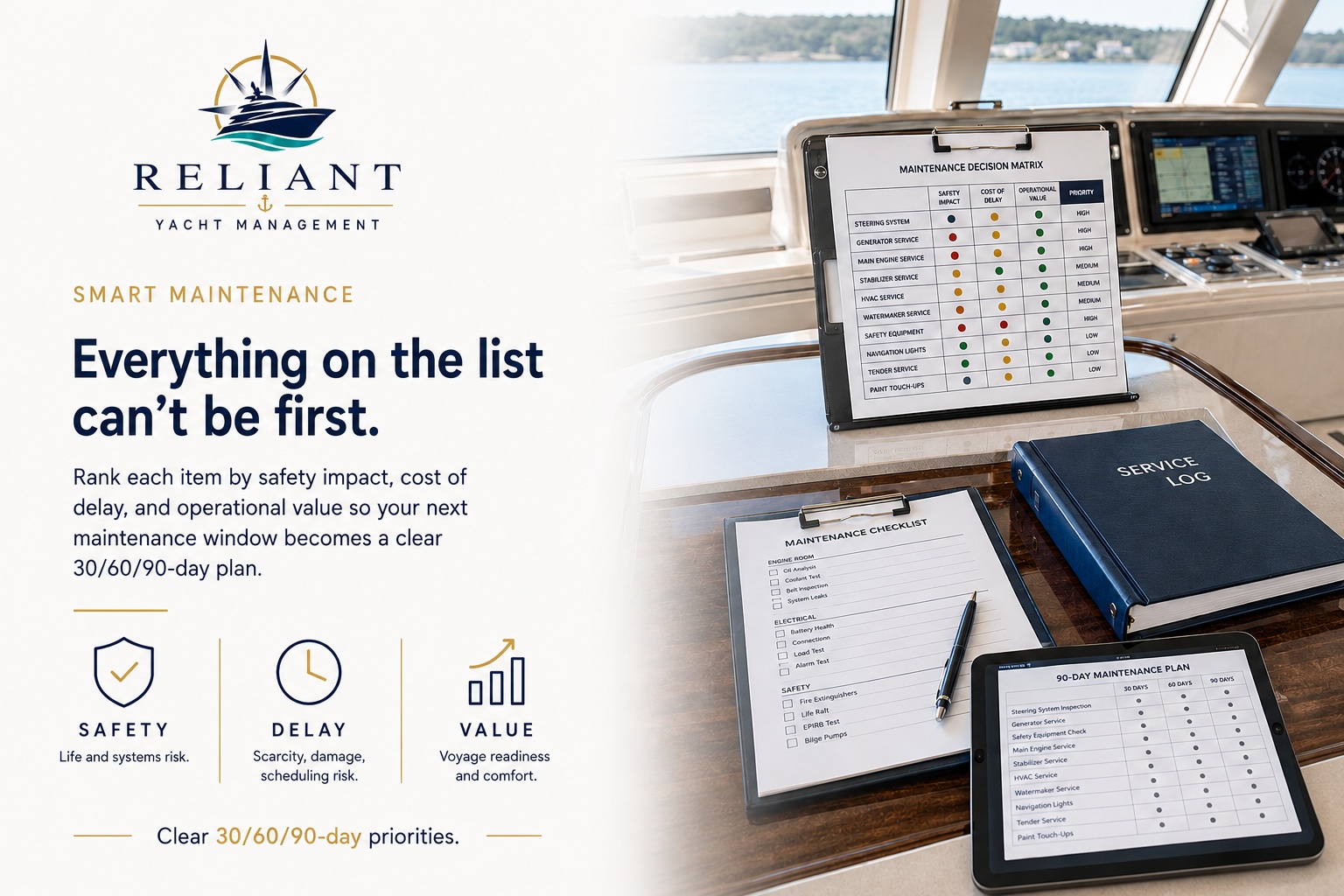
Turning that list into a clear decision map—ranked by safety impact, cost of delay, and operational value—helps owners make calm, confident decisions instead of reacting to the loudest vendor or the latest “urgent” recommendation.
Why a Decision Map Beats a To‑Do List
A typical maintenance list treats every item as equal: a sticky throttle cable sits next to a cosmetic gelcoat chip. In reality, those two items do not carry the same risk, urgency, or value.
A simple decision map changes that by answering three core questions for each item:
- How does this affect safety?
- What will it cost—financially and operationally—if I delay it?
- How much will this improve my ability to use and enjoy the yacht?
When each task is scored through those lenses, priorities come into focus and the stress level drops. You are no longer asking, “What do I fix?” but instead, “What should I address first, with the time and budget I have?”
Step 1: Start With a Structured Maintenance Inventory
Begin by capturing everything in one place. That list should come from:
- Recent surveys and haul-outs
- Captain or crew notes
- Yard and mechanic recommendations
- Your own observations after trips
- Findings from professional inspections
For each item, write down:
- What it is (e.g., “Replace port engine raw-water pump”)
- Where it is on the vessel
- Who identified it
- Any visible symptoms (noise, leaks, alarms, vibration)
This is where a platform like Reliant Vessel Intelligence is valuable: it keeps photographs, notes, and dates attached to every issue so you are not relying on memory or email threads.
Step 2: Rank by Safety Impact First
Safety is the non‑negotiable starting point. Rank each item on a simple scale:
-
High safety impact – Could cause loss of propulsion or control, fire, flooding, or critical navigation failure.
Examples:- Steering or throttle issues
- Fuel leaks or persistent fuel odors
- Bilge pump failures
- Corroded shore-power connections and breakers
- Engine overheat alarms, unresolved
-
Moderate safety impact – Not immediately dangerous, but could compromise safety if conditions worsen or if other systems fail.
Examples:- Aging but functional navigation lights
- Worn but intact running rigging (on sailing yachts)
- Marginal battery capacity for house systems
-
Low safety impact – Primarily cosmetic or comfort-related.
Examples:- Interior upholstery wear
- Minor gelcoat crazing above the waterline
- Cosmetic corrosion on hardware
In practice, any item with high safety impact belongs in a “must address soon” category, regardless of how inconvenient the timing may be.
Step 3: Evaluate the Cost of Delay
Next, assess what happens if the work waits. The “cost of delay” is more than the future invoice; it includes:
- Escalation risk – Will this become a larger, more expensive repair?
- Collateral damage – Can it harm other systems if ignored?
- Seasonal and access factors – Is there a narrow weather or yard window?
Rank each on another simple scale:
-
High cost of delay
- A small deck leak above cabinetry that can lead to rot and mold
- Rust on exhaust components that, if left unchecked, can damage engines
- Early signs of electrolysis on running gear
- Minor fuel leaks that can contaminate bilges and create costly cleanups
-
Moderate cost of delay
- Canvas and isinglass starting to cloud or crack
- Intermittent electronics issues that may worsen without diagnosis
- Batteries approaching end of life but still testing adequate
-
Low cost of delay
- Cosmetic dings and scratches
- Non-structural interior finishes
- Upgrades driven purely by preference, not need
This step often moves an item up the list that does not “feel” urgent but will be far more expensive if it waits.
Step 4: Consider Operational Value
Finally, look at how each task affects your ability to enjoy the yacht the way you intend to use it over the next season.
Ask:
- Does this prevent me from using the yacht at all?
- Does it limit how far, how often, or in what conditions I am comfortable running?
- Will it reduce guest comfort to the point that we avoid inviting people aboard?
Rank operational value roughly as:
-
High operational value
- Generator reliability for overnight trips
- Air conditioning in Florida summers
- Windlass repairs if you anchor frequently
- Reliable tender for accessing shore
-
Moderate operational value
- Autopilot tuning for longer passages
- Entertainment systems for family cruising
- Additional electronics that enhance but do not enable operation
-
Low operational value
- Non-essential décor changes
- Upgrading functioning equipment purely for aesthetics
This category acknowledges that while some items are not safety-critical, they are central to why you own the yacht in the first place.
Step 5: Build Your Maintenance Decision Map
With three rankings in place, patterns emerge. A simple way to prioritize:
-
Tier 1: Address immediately
- High safety impact, regardless of other scores
- Moderate safety + high cost of delay
-
Tier 2: Plan and schedule
- Moderate safety + moderate/high operational value
- Low safety + high cost of delay
-
Tier 3: Defer with intention
- Low safety + low cost of delay + low operational value
For each tier, document:
- Target timing (e.g., “before hurricane season,” “next haul-out”)
- Responsible vendor or yard
- Estimated budget range
- Any dependencies (e.g., “Do while boat is hauled”)
An owner’s representative can help refine this map, validating which items truly belong in Tier 1 versus Tier 2 and preventing over-servicing driven by vendor sales goals.
Step 6: Use Documentation to Make Calm, Confident Decisions
A decision map is only as good as the information behind it. Detailed documentation turns difficult choices into straightforward trade-offs:
- Inspection photos show progression (or stability) over time.
- Service history reveals whether you are chasing symptoms or solving root causes.
- Clear notes capture what was recommended, what was approved, and why.
This is the philosophy behind Reliant’s Vessel Intelligence platform: every inspection, issue, recommendation, and completed repair is logged so you can:
- See what changed since last visit
- Understand why a recommendation is made
- Compare “before and after” on completed work
- Track what is planned for your next visit to the dock or yard
With that level of visibility, you can say “yes,” “not yet,” or “show me more” with confidence—whether you are in town or across the country.
Turning Overwhelm Into Stewardship
A long maintenance list does not have to feel like a verdict on your yacht; it is simply a snapshot of where attention is needed. When you:
- Rank every item by safety impact
- Understand the cost of delay
- Weigh the operational value to how you actually use the vessel
- Rely on thorough documentation instead of memory or pressure
…your role shifts from putting out fires to practicing thoughtful, proactive stewardship.
If you would like help turning your yacht’s maintenance list into a clear decision map—with professional eyes on the vessel and complete visibility ashore—Reliant Yacht Management is here to support you. Reach out to schedule an initial vessel review and see how professional care and organized intelligence can simplify your ownership experience.