Building a Vessel Condition Baseline: The First 60 Days of Responsible Yacht Management
When a yacht is new to you—or newly brought under professional management—the first 60 days are critical. Decisions made in this window determine whether the next few years feel organized and predictable, or reactive and expensive.
A responsible yacht-management program begins by building a clear, well-documented vessel condition baseline. This is more than a quick walk-through or a stack of invoices from the last owner. It is a structured process of inspections, photography, equipment identification, and record-gathering that answers three essential questions:
- What is the yacht’s true condition today?
- What work has been done—and what has been missed?
- How will we track changes, wear, and projects over time?
Below is how Reliant approaches the first 60 days for a new or newly managed vessel.
Why a Vessel Condition Baseline Matters
Without a baseline, owners often face:
- Disputes over what was “already like that” versus “new damage”
- Confusion about whether vendor work was completed as promised
- Missed maintenance intervals and expensive catch-up repairs
- Uncertainty about what equipment is actually onboard and how it should be serviced
A documented baseline:
- Protects the owner in disagreements or warranty questions
- Gives vendors clear reference points when recommending work
- Reduces surprises by revealing hidden issues early
- Provides confidence that every future recommendation is grounded in facts, not guesswork
Phase 1 (Days 1–10): Onboarding and Initial Walk-Through
The first step is understanding the yacht as it exists today—before changes begin.
Owner interview and expectations
Reliant starts with a structured conversation covering:
- How the yacht will be used (local cruising, extended trips, charter, etc.)
- Who will run the boat (owner-operator, captain, mixed use)
- Prior maintenance habits and known chronic issues
- Recent yard periods, upgrades, and unresolved survey items
- Tolerance for downtime and preferred schedule for maintenance
This context shapes how aggressive the initial review and preventive planning should be.
Condition-oriented walk-through
Next comes a detailed, condition-focused walkthrough—not a social tour. We:
- Identify obvious leaks, corrosion, staining, and safety issues
- Note evidence of deferred maintenance (filters, hoses, belts, fluids, anodes)
- Check critical systems for basic operation: engines, generators, DC/AC power, bilge systems, navigation, HVAC, watermakers (if installed)
- Confirm documentation basics: registration, insurance, manuals on board, labeling
Findings are captured immediately, not left to memory. This walk-through sets priorities for the deeper inspection work that follows.
Phase 2 (Days 10–30): Structured Inspections and Photo Sets
Once the yacht’s general picture is clear, Reliant develops a systematic inspection and photography plan. The goal is to create a repeatable process, not a one-time event.
Standardized inspection checklists
We build vessel-specific inspection checklists that typically cover:
- Exterior: hull, topsides, rails, deck hardware, seals, caulking, windows, hatches, canvas
- Machinery spaces: engines, generators, shafts, stuffing boxes or seals, exhaust, fuel systems, coolant, hydraulics
- Electrical: shore power connections, batteries, chargers, inverters, panel labeling, corrosion indicators
- Plumbing: freshwater, blackwater, greywater, bilge pumps, seacocks and strainers
- Safety: fire systems, extinguishers, flares, life rafts, PFDs, alarms, emergency gear
- Interior: leaks, staining, soft spots, joinery movement, odors, mold risk
The same inspection structure will be used again and again over time to spot changes—not just to point out problems once.
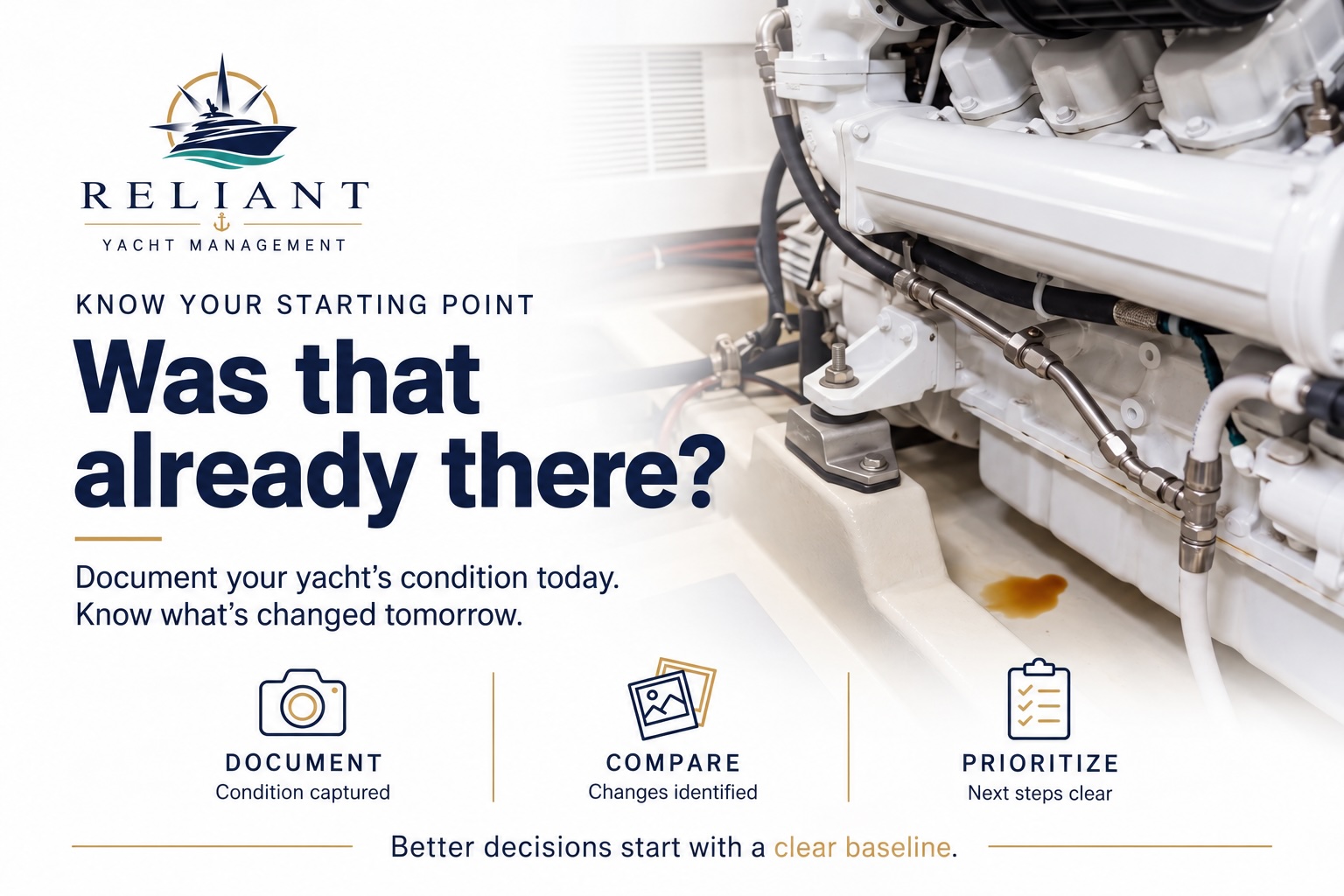
Baseline photo documentation
Consistent, repeatable photo sets are one of the most powerful tools for preventing disputes and surprises. Reliant captures:
- Wide-angle shots of key spaces (engine room from each corner, lazarette, bilge areas, helm, accommodations)
- Close-up shots of vulnerable components (hoses, clamps, seacocks, through-hulls, batteries, terminals, shaft seals, exhaust sections, strainers)
- “Before” images of any areas with existing cosmetic or structural defects
- Serial plates, labels, breaker panels, and control interfaces
Photos are taken from the same angles and distances wherever possible. Over time, this lets us compare “then vs. now” to spot corrosion spread, new staining, worn insulation, leaks, or movement.
Phase 3 (Days 20–40): Equipment Identification and Record-Gathering
A yacht cannot be properly managed if you do not know what is actually installed aboard.
Building the equipment inventory
We identify and log:
- Engines, gears, generators, and major driveline components
- Electrical gear (chargers, inverters, transformers, battery banks, major breakers)
- Navigation and communication electronics
- Pumps, watermakers, thrusters, stabilizers, windlasses, cranes/davits
- HVAC units and refrigeration
- Major appliances and specialty systems
For each, Reliant records brand, model, serial number, location, and any visible condition notes.
Collecting and organizing records
Next, we gather:
- Prior surveys and sea-trial reports
- Yard invoices, engine service records, and major repair documentation
- Warranty paperwork and extended coverage details
- Manufacturer manuals and recommended service intervals
Where documents are missing, Reliant retrieves OEM manuals and service bulletins directly from manufacturers and integrates them into the vessel record.
Our Reliant Vessel Intelligence platform consolidates all this into a single operational record—no more chasing scattered emails, PDFs, and text threads when you need to know what was done, when, and by whom.
Phase 4 (Days 30–60): Preventive Maintenance Plan and Owner Visibility
With inspections, photos, equipment lists, and records in hand, we can transition from “fact-finding” to proactive management.
Preventive maintenance schedule
Using the equipment inventory and OEM guidance, Reliant builds a vessel-specific preventive maintenance plan that:
- Prioritizes safety- and reliability-critical items first
- Aligns work with your actual use pattern and cruising plans
- Flags overdue items that should be addressed in the next service window
- Separates “must-do” work from “nice-to-have” upgrades
Our platform uses AI to help extract manufacturer requirements and organize them into practical schedules—but experienced captains and marine technicians always make the final decisions.
Project list and risk reduction
We create a clear, written project list:
- Immediate items (safety issues, active leaks, failing components)
- Near-term items (upcoming engine hours, manufacturer intervals, worn but functional gear)
- Long-term planning (upgrades, refit work, end-of-life systems)
Each recommendation is documented with photos, context, and reasoning so owners can see why it matters, not just what it costs.
Ongoing visibility for remote owners
For absentee owners, seasonal residents, and busy professionals, the key outcome of the first 60 days is confidence. Going forward, you should have:
- A clear snapshot of your yacht’s condition
- Documented inspections, with photos and comments
- A live record of service history and open projects
- Reduced ambiguity when vendors recommend work
- A trusted advocate verifying that work was completed correctly
Reliant’s recurring inspections and documented oversight ensure that every visit to your yacht feels less like an unknown and more like stepping aboard a well-cared-for vessel.
The Real Measure of Responsible Management
The first 60 days are not about how many repairs can be coordinated. They’re about:
- How many future problems can be prevented
- How clearly you understand your yacht’s condition
- How confidently you can leave the dock knowing someone is looking after your vessel as carefully as you would yourself
If you’ve recently purchased a yacht or feel uneasy about what you don’t know about your vessel’s true condition, Reliant can help establish a proper baseline and ongoing management program.
Contact Reliant Yacht Management to schedule an initial consultation and put professional care aboard with complete visibility ashore.