Preventive Maintenance vs. Reactive Fixes: A Simple Decision Tree for Yacht Owners
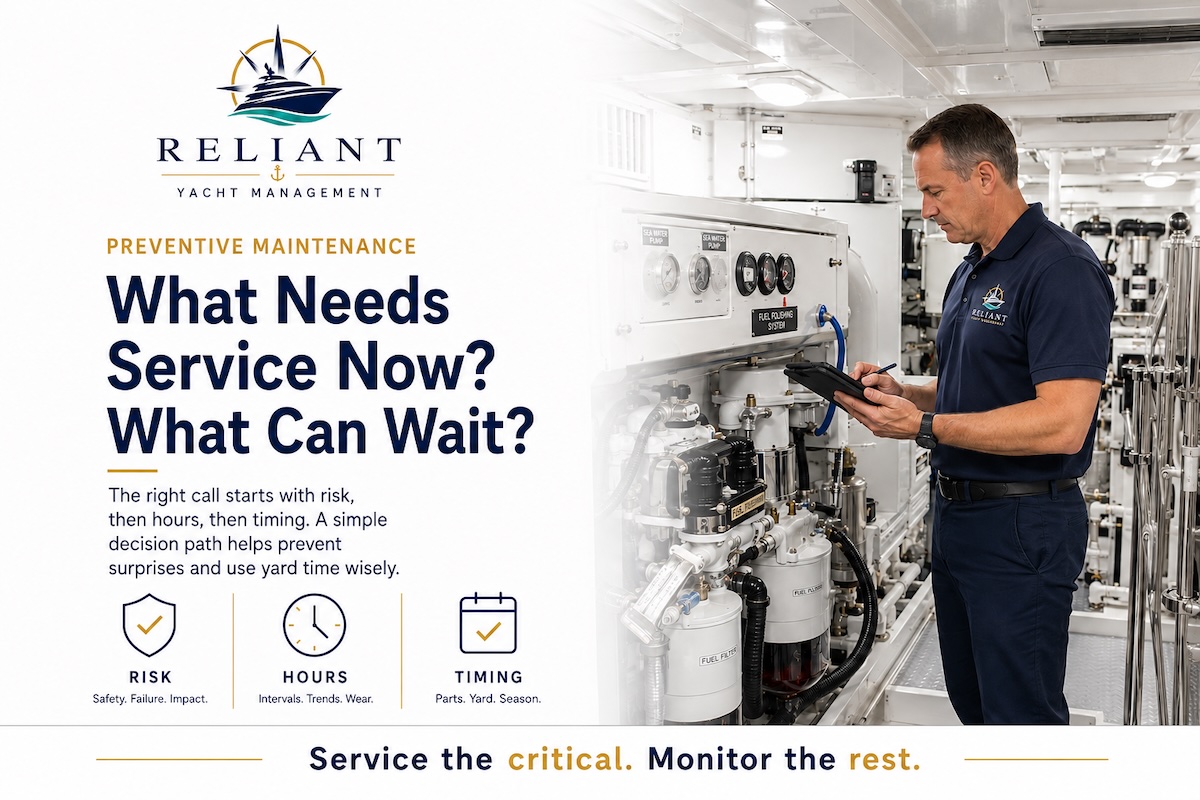
Yacht ownership always involves tradeoffs: time vs. money, convenience vs. control, preventive maintenance vs. “fix it when it breaks.” The challenge is knowing what truly needs attention now and what can be safely monitored without increasing your risk of major failure, lost trips, or expensive surprises.
This is where a simple, practical decision framework helps. You don’t need to be a full-time captain to think like one—you just need a structured way to prioritize.
Below is a straightforward decision tree you can apply to most systems on your yacht, followed by examples and practical tips for owners managing a vessel from a distance.
Step 1: Is This Safety-Critical?
Start with the most important question:
“If this fails unexpectedly, can it put people at risk?”
If yes, it belongs in the service-now category or on a strict, proactive maintenance schedule.
Safety-critical systems typically include:
- Engines and propulsion (including fuel and cooling systems)
- Steering and control systems
- Bilge pumps and high-water alarms
- Electrical distribution and battery systems
- Navigation lights and core electronics used for safe operation
- Fire suppression and ventilation systems
- Ground tackle (anchor, chain, windlass) when cruising or anchoring regularly
Decision:
- Any known defect, intermittent fault, or overdue service on these systems should be addressed proactively, not left to “see what happens.”
- Monitoring alone is only suitable if a qualified professional has inspected the system, documented its condition, and set clear inspection intervals.
Step 2: What Is the Consequence of Failure?
If the system isn’t directly safety-critical, ask:
“What happens if this fails without warning?”
Consider consequences in three categories:
-
Operational impact
- Will it cancel a trip, cut a weekend short, or leave you stranded?
- Example: generator failure during peak summer heat.
-
Financial impact
- Will deferring maintenance likely turn a small, predictable expense into a major repair?
- Example: ignoring a minor shaft seal weep that eventually becomes a flooded bilge.
-
Secondary damage
- Can this failure damage other systems or the vessel itself?
- Example: a clogged air-conditioning condensate drain overflowing into cabinetry.
Decision:
- If failure would disrupt your use of the yacht, cause secondary damage, or multiply repair costs, the item usually belongs in preventive maintenance, not “wait and see.”
Step 3: Is There Evidence of Deterioration?
Next, look for real-world clues:
- New or worsening noises, vibrations, or odors
- Changes in temperature (hotter than usual components)
- Fluid leaks, corrosion, staining, or unusual moisture
- Performance changes (slow starts, reduced output, nuisance alarms)
- Irregular wear in belts, hoses, filters, or anodes
Decision:
- Any trend of decline moves an item toward service-now or schedule-soon.
- If the deterioration is mild and well-understood, you may choose to monitor with documented inspections—but not ignore it.
This is where consistent inspections and good records matter. It’s much easier to justify preventive maintenance when you can see how an issue has evolved over weeks or months.
Step 4: What Is the Manufacturer’s or Surveyor’s Recommendation?
Preventive maintenance is not guesswork; it’s usually well-defined by:
- Manufacturer service intervals (hours, seasons, or calendar dates)
- Surveyor recommendations from a purchase or insurance survey
- Known patterns for your specific make/model and operating environment
Decision:
- Core systems (engines, generators, drives, fuel, cooling, steering, and electrical) should follow or exceed manufacturer and surveyor guidance.
- You can sometimes defer strictly cosmetic or comfort-related items, but not structural or mechanical recommendations.
Where flexibility exists, a professional manager can help you prioritize:
- What must be done this season
- What should be planned for the next haul-out
- What can reasonably wait while being documented and monitored
Step 5: How Often Is the Yacht Used—and How Far From Help?
Your usage profile matters as much as the system itself:
- Heavy-use vessels (frequent trips, long runs, charters, or remote cruising) demand more preventive maintenance.
- Light-use vessels still need regular exercise and scheduled care to avoid sitting-related issues: stale fuel, battery sulfation, seized valves, and corrosion.
Your distance from the boat also changes the calculus:
- If you live out of state or travel frequently, the cost of a ruined weekend or emergency service call can far exceed the cost of a scheduled service you never notice because the boat simply “works.”
Decision:
- The more you rely on the yacht “just working” when you arrive, the more you should lean toward preventive care + documented oversight.
Step 6: Do You Have Clear, Current Documentation?
Finally, ask:
“Do I actually know the last time this was inspected or serviced?”
If the answer is “I think” or “I’m not sure,” you lack the visibility needed to confidently defer service.
Reliable documentation should include:
- Date and details of last service
- Who performed it and what was observed
- Photos of key areas and components
- Any recommendations that were deferred and why
- Follow-up inspection dates
Decision:
- Without documentation, you’re guessing. Guessing tends to push owners into either overspending out of caution or under-maintaining out of optimism—neither is ideal.
A Practical Decision Tree in Plain Language
When you’re unsure whether to act now or monitor, walk through these questions:
-
Is it safety-critical?
- Yes → Service now or schedule promptly.
- No → Go to 2.
-
Could failure cause major cost, damage, or trip cancellation?
- Yes → Preventive maintenance recommended.
- No → Go to 3.
-
Is there evidence of deterioration or a trend?
- Yes → Inspect and service soon; don’t just watch it indefinitely.
- No → Go to 4.
-
Are you within manufacturer/survey intervals?
- No → Bring it current.
- Yes → Go to 5.
-
Is the vessel heavily used or remotely managed?
- Yes → Lean preventive; schedule periodic checks and documented inspections.
- No → Monitoring with defined inspection intervals may be reasonable.
-
Do you have clear documentation and photos?
- No → Prioritize a professional inspection and baseline report.
- Yes → Use your history to refine when to service vs. monitor.
How Professional Oversight Makes This Easier
Applying this framework consistently takes time, access, and experience. Many owners:
- Live several hours or states away
- Manage demanding careers
- Prefer to spend their limited time aboard enjoying the yacht, not tracing wiring or chasing vendors
A professional owner’s representative bridges that gap by:
- Inspecting your yacht regularly with a consistent checklist
- Documenting findings with photos, notes, and trends over time
- Prioritizing recommendations based on risk, consequence, and your usage
- Verifying that vendors did exactly what they billed for
- Keeping your operational history organized so future decisions are faster and better informed
At Reliant Yacht Management, our Vessel Intelligence platform turns this approach into a clear, living record of your yacht—every inspection, every issue, every completed project—so preventive maintenance becomes straightforward instead of stressful.
Want Help Turning “I Hope It’s Fine” into “I Know It’s Ready”?
If you’re ready to replace guesswork and reactive fixes with calm, documented oversight, Reliant Yacht Management can help.
Contact us to discuss a tailored yacht management and inspection program that keeps your vessel ready—and your weekends focused on the water, not the work.