

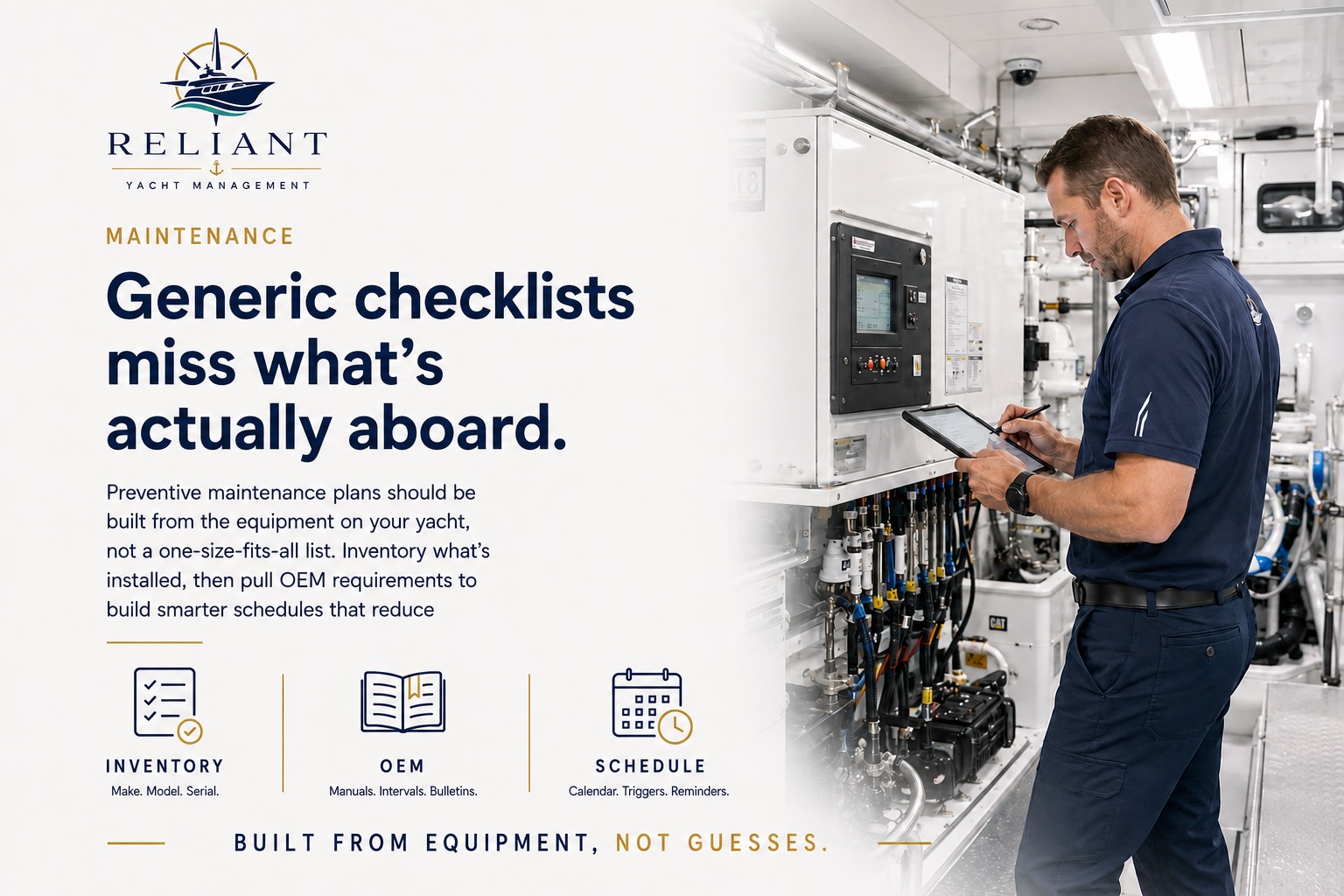
Two boats can leave the factory the same week, as the same model, and need different maintenance five years later. One has a newer generator. The other had her battery charger replaced along the way, and nobody wrote down the make. A maintenance plan built from the brochure, or from a generic checklist, treats them as twins.
A plan that protects your boat starts with what’s installed aboard her, then follows what each manufacturer says that equipment needs. It also gives you something to show for warranty, insurance and resale, while the final calls on the work stay with the people doing it. That holds for an owner who closed on a first boat last month and for one who has run the same boat for ten seasons.
Start with what’s actually aboard
The first job is an inventory. Record the engines and generator by make, model, serial number and engine hours, then the AC units, the battery bank and charger, the pumps, the seacocks and through-hulls, and the raw-water strainers. Belts and hoses get noted alongside the equipment they serve.
For a new owner, this pairs naturally with the survey. The survey describes the condition of what’s there. The inventory turns it into a list you can maintain against, and together they give you a condition baseline for the first season.
Equipment changes over the years through repairs and upgrades, and the paperwork doesn’t always follow. A plan written for the original fit-out can keep asking for the wrong filter on a unit that left the boat long ago.
Let the manufacturer set the intervals
Each piece of equipment comes with its manufacturer’s service requirements: the intervals, the filters and fluids specified, and the parts meant to be replaced on a schedule rather than when they fail. Engine manufacturers commonly set service intervals by hours or by time, whichever comes first.
That time limit matters in Florida. A boat that sits through the summer may log very few hours and still be due, because heat, humidity and salt work on her whether the engines run or not. Engines that sit need more attention, not less.
On top of the manufacturer’s schedule, the plan adds what the climate asks for. Raw-water strainers clog and condensate drains back up while a boat sits closed. Dock lines and chafe gear wear in the sun. Those checks go in the plan because of where she’s kept, on the Space Coast or in Southwest Florida.
What a generic checklist costs you
A checklist that wasn’t written for your boat fails in two directions. It schedules work your equipment doesn’t need, which costs money. And it misses work your equipment does need, which usually shows up as downtime, often on the weekend you’d planned to use her.
Planned work also gives you room. Vendors can be booked ahead, estimates can be reviewed before you spend, and jobs can be grouped so a boat isn’t opened up three times for three small things. Unplanned repairs rarely allow any of that.
A schedule you can see from anywhere
On every boat we manage, the plan and its records live in Harbor Guardian, the platform we use for inspections and maintenance. Inspections follow checklists with reference photos, so the same equipment is looked at the same way each visit. Each job becomes a work order and stays open until it’s verified with a proof photo.
Inspection photos are also compared with earlier photos of the same equipment and spaces, which can surface possible changes like corrosion, weeping or wear. A person reviews each flagged change and decides what it means. Everything ends up in a dated service history you can open on your phone, wherever you are.
Warranty, insurance and resale
Many equipment warranties are tied to following the manufacturer’s maintenance schedule, and a claim can come down to whether you can show the work was done. Terms vary, so read your own warranties, and confirm anything you’re unsure of with the manufacturer or dealer.
Insurers and surveyors also look at how a boat has been kept. A dated service history with photos, organized by the equipment actually aboard, holds up far better than a folder of loose receipts, at renewal and when it’s time to sell. Your insurer is the one to confirm what they require.
People make the final call
A plan sets the starting points. The technician who opens up an engine, or the surveyor who inspects the hull, decides what it really needs. A flagged change in a photo is a reason to look closer, never proof that something has failed, and specialist work goes to the right professional.
When we bring findings to you, we keep urgent repairs apart from planned maintenance and optional improvements, with estimates and no vendor markups. You see what matters now, what can wait, and what it will cost before anything is approved.
Message us with your boat and where she’s kept, and we’ll arrange a first inspection and build her plan from what’s actually aboard.