

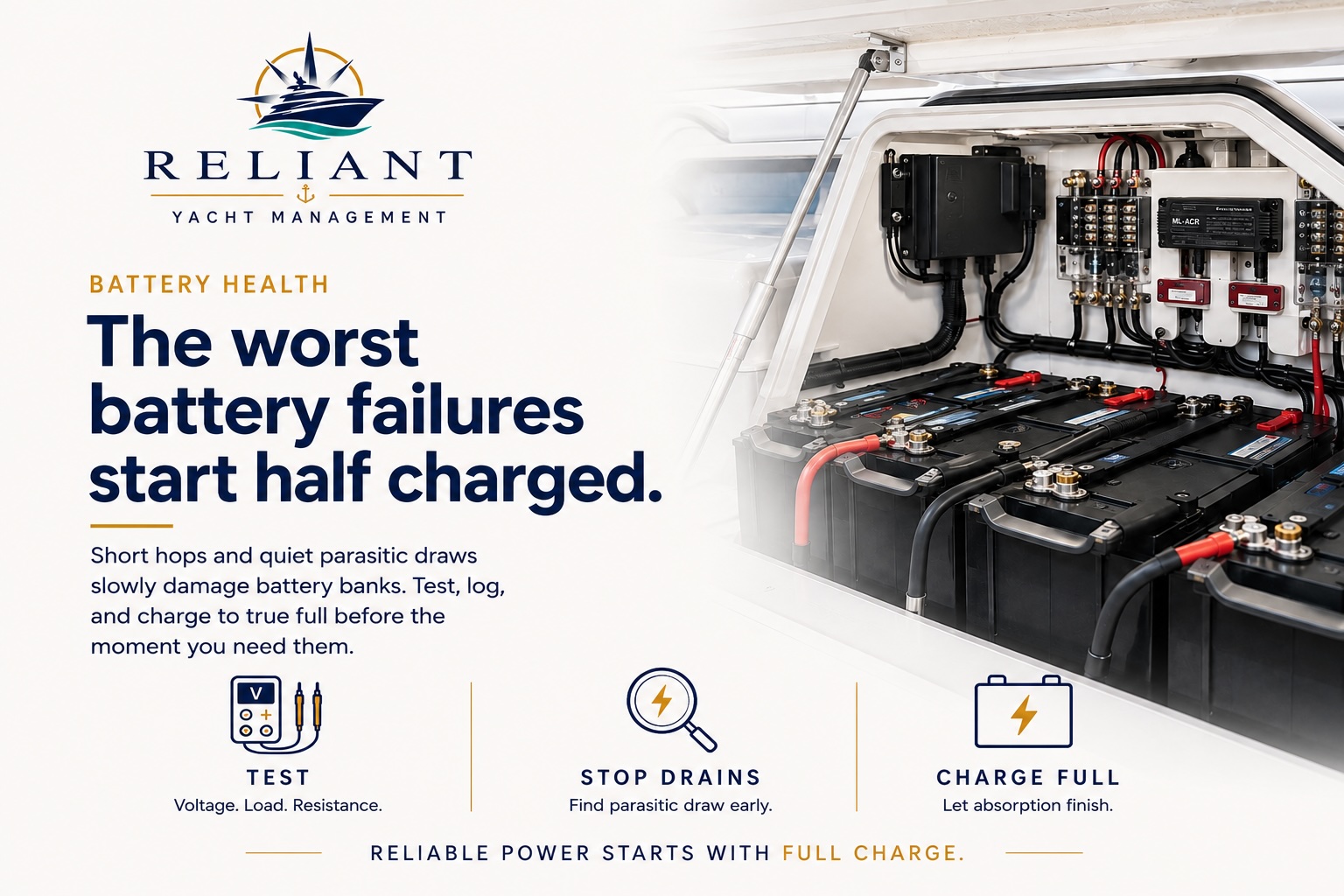
A battery can read fully charged and still be on its way out. The panel shows a healthy voltage, the cabin lights come on, and nothing looks wrong. Then one morning you turn the key, and the starter barely turns over.
The overlooked reason is the gap between what a battery shows at rest and what it can deliver under load. On a boat that sits, that gap widens quietly, and a dated record of test results is what shows it.
Why a resting reading can fool you
Resting voltage tells you roughly how charged a battery is. It says much less about capacity, which is how much energy the battery can actually hold and hand over.
In a lead-acid battery, capacity fades as sulfate builds up on the plates. That happens fastest when the battery sits partly charged for weeks at a time, which is exactly what a boat waiting at the dock tends to do. The resting voltage can stay close to normal while the usable capacity shrinks underneath it. Light house loads keep running fine. The starter asks for a large current all at once, and a weakened battery can’t supply it.
Florida’s climate makes this worse. Heat speeds up the chemistry that wears batteries out, so a battery in a warm engine room on the Space Coast or in Southwest Florida generally ages faster than the same battery kept somewhere cooler.
What leaves batteries half charged while you’re away
A boat at the dock should be on shore power, with the charger keeping the batteries topped up. A few ordinary problems interrupt that without anyone noticing:
- a tripped breaker at the pedestal or on the boat’s panel
- a worn or loose shore-power inlet that stops passing power reliably
- a charger set for the wrong battery type, so it undercharges or overcharges
- small constant draws, like electronics memory or a switch left on
Any one of them can leave a battery partly charged for weeks. The battery doesn’t fail that day. It loses a little capacity each week, and you find out when she’s needed.
How to test a battery properly
No single number tells the whole story, so a good check combines a few readings.
Start with resting voltage, taken after the battery has been off the charger long enough for the surface charge to settle. Then run a load test or a conductance test, which shows how the battery holds up when it’s asked to work. On flooded batteries, check the electrolyte level and use a hydrometer to read the specific gravity of each cell. One weak cell can drag down the whole battery even when the others look fine.
AGM and lithium batteries are sealed, and lithium banks have their own battery management system with their own rules. For those, follow the manufacturer’s guidance, and bring in a marine electrician for anything beyond a visual check and a reading.
While you’re at the battery, look closely at the terminals. Corrosion or a terminal that isn’t fully tight adds resistance right where the starter needs the most current. Then confirm the charger’s settings match the battery chemistry actually installed, especially if the batteries have been replaced with a different type since the charger was set up.
Why the log matters more than any single test
One reading tells you where a battery stands today. A dated series of readings tells you where it’s heading.
A useful battery log is simple: the install date, resting voltage, load or conductance results, the condition of the terminals and the engine hours at each check. When the load results slip over a few checks, you can plan the replacement at the dock, on your schedule, instead of discovering the problem the morning you planned to leave.
The log also settles the question at replacement time. Batteries in the same bank are generally best replaced together, and the record shows how old each one is and how it has behaved.
Habits that help batteries last
Batteries last longer when they stay charged and never get run flat. The charger profile should match the chemistry, the terminals should stay clean and tight, and the shore-power connection should be sound from the pedestal to the inlet. Checking on a regular schedule means a fading battery shows up as a trend in the record rather than a surprise at the helm.
How we handle batteries when we manage your boat
When we manage your boat, battery condition is part of every inspection. We check the batteries and terminals, the charger and the shore-power inlet, and record what we find.
Each finding goes into Harbor Guardian with photos, location and severity, and it becomes part of your boat’s dated service history. Photos of the terminals are compared with earlier photos of the same spot, and a person reviews any possible change, such as new corrosion, before deciding what it means. You can see the findings and photos from your phone, wherever you are.
If a battery is fading, we tell you plainly and keep it separate from optional upgrades, so you know what’s urgent and what can wait. Replacement work comes with an estimate and no vendor markup, and the job stays open until it’s verified with a proof photo.
Message us with your boat and where she’s kept, and we’ll set up a first inspection.