
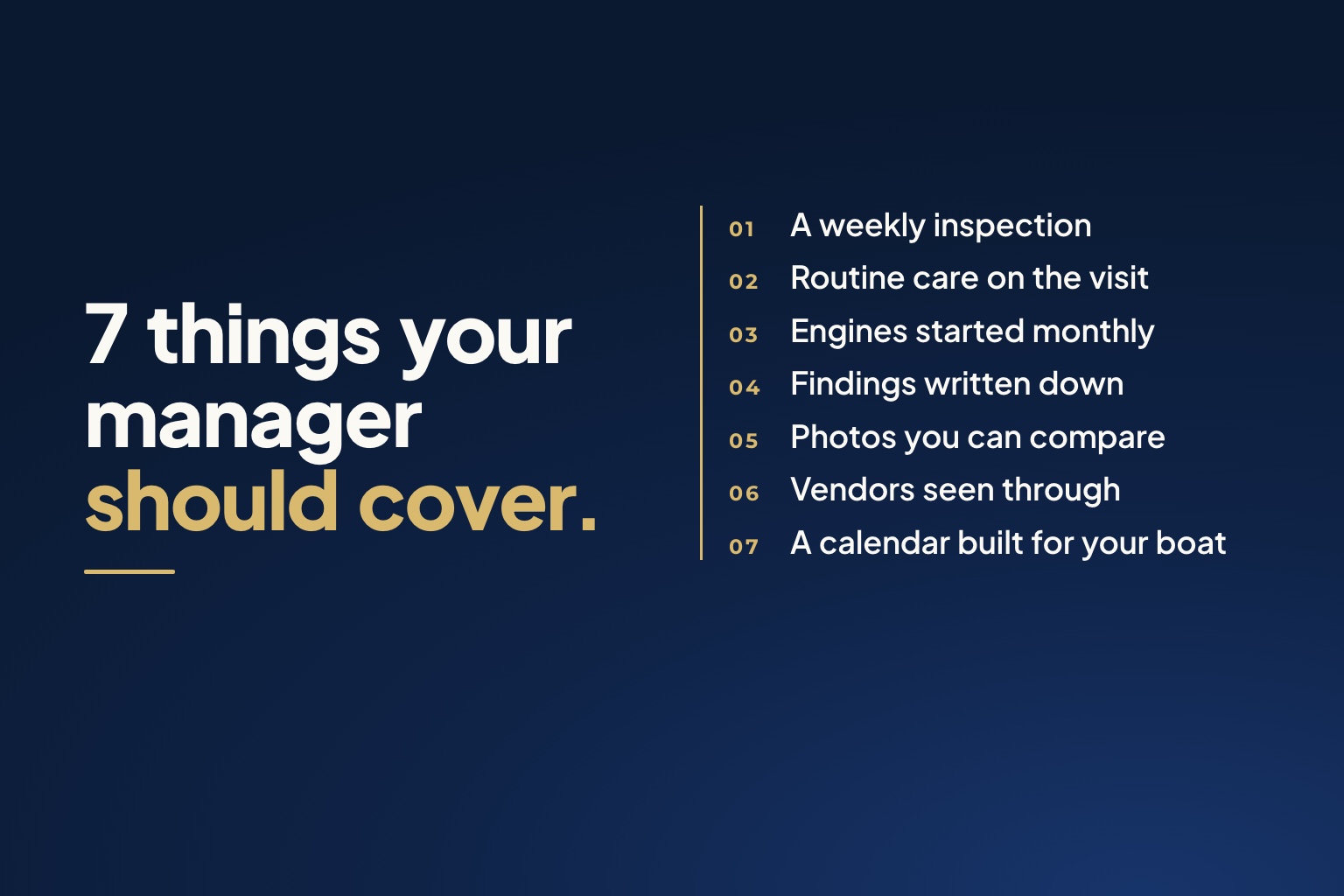
A yacht management checklist covers seven things: a weekly inspection, routine care done during that visit, monthly engine and generator starts when the boat hasn’t been used, findings written down with photos, photos compared over time, vendor work followed to a verified finish, and a maintenance calendar built around your boat. Each one leaves a record you can ask to see.
The records matter most if you’re short on time or don’t know your boat’s systems well enough to judge the work. You don’t need to know your generator inside out to tell whether it’s being looked after. You read the record. If you’d rather know what to check aboard yourself, The weekly and monthly checks that keep your boat ready covers that. This list is about what to expect from the people you pay to do it.
1. A weekly inspection
Someone goes aboard every week. They check the bilge, power, batteries, fluids and systems, then the dock lines, fenders and the shore-power connection.
In Florida the air conditioning is normally left running to keep humidity down, so each visit confirms it’s actually working. If it stops between visits, humidity builds in a closed-up cabin.
What to ask to see: a dated record of every inspection, with photos.
2. Routine care done on the visit
Some jobs don’t need a vendor and shouldn’t wait for one. Air-conditioning filters and fuel filters are changed when they’re due. Sea strainers for the engines, generators and air conditioning are checked regularly and cleaned on site when they need it. Fire extinguishers are checked too.
What to ask to see: when each filter was last changed, and photos of the strainers. That tells you what was done and what comes due next.
3. Engines and generators started once a month
If the boat hasn’t been run, the engines and generators are started once a month.
What to ask to see: a dated note of each start.
4. Findings written down, not remembered
“Looks good” isn’t a report. When something turns up on an inspection, it gets written down with a location, a category and a severity of low, medium or high, plus photos.
That structure lets you tell an urgent repair from something that can wait for the next haul-out. You decide where the money goes before you spend it.
What to ask to see: the list of open findings, each with its severity and photos.
5. Photos you can compare
A single photo shows how something looks today. A series shows how it’s changing. New inspection photos are compared with earlier photos of the same equipment to surface possible changes, such as corrosion, wear or discoloration, and a person reviews each one and decides what it means.
Comparison doesn’t find every problem, and a flagged change doesn’t prove anything has failed. It tells someone where to look closer, and someone does.
When we manage your boat, you have your own sign-in to Harbor Guardian, where you can see inspections, photos, findings, work in progress and costs. What Harbor Guardian Does and What It Doesn’t explains where its part ends and ours begins.
What to ask to see: your own access to the record, not a summary.
6. Vendors managed through to a verified result
Repairs and maintenance work are done by vendors. The manager’s job is everything around that work: collecting estimates, scheduling access to the boat, following the job and confirming it’s finished. A job stays open until the result is verified.
Vendor invoices are passed through with no markup and no hidden fees, so the cost you see is the cost of the work. For a wider look at how to judge this before you hire, see 7 questions to ask a yacht management company before you hire.
What to ask to see: the vendor’s own invoice, and a proof photo of the finished work.
7. A maintenance calendar built around your boat
A generic schedule treats every boat the same. A useful one is built around your boat’s own equipment, her service history and how she’s used. A boat that goes out most weekends and one that sits for weeks at a time wear differently.
Build a maintenance calendar that prevents breakdowns goes through how that calendar comes together.
What to ask to see: the calendar itself, with your boat’s equipment on it.
How we work at Reliant
Every plan we take on starts with an initial vessel review. From that review we write a management plan that sets out the scope of what we’ll handle and the fee. There’s no contract. It runs month to month.
We manage boats in Cape Coral and Southwest Florida, and at Port Canaveral and across the Space Coast.
Message us with your boat and where she’s kept, and we’ll start with a vessel review.