
If you already have a captain you trust, do you need a yacht manager too? Experienced owners ask it, and it tends to come up when something has slipped through the gap between the two.
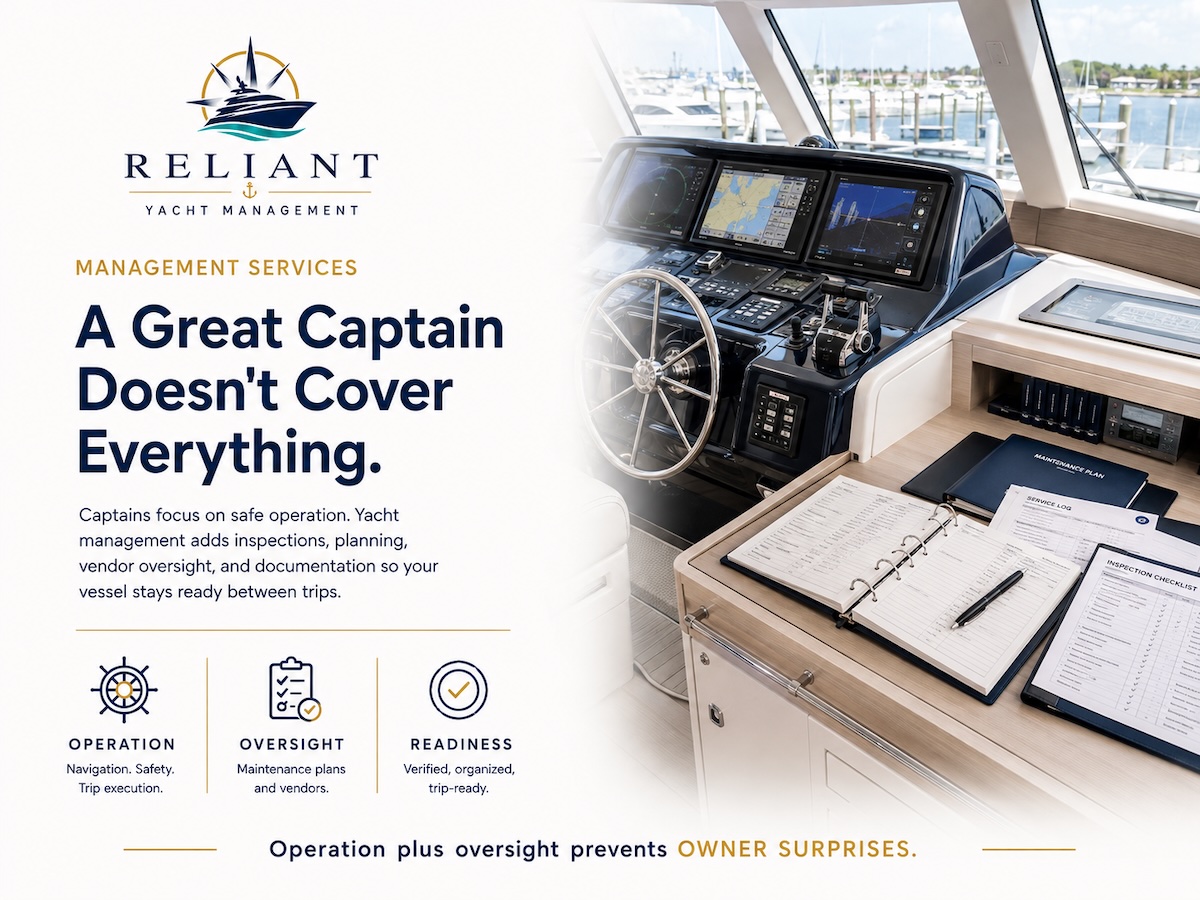
They do different jobs. A captain looks after your boat while she’s underway. A manager looks after her the rest of the time, speaks up for you with vendors and yards, and keeps one record so nothing a captain notices gets lost before the next trip. This piece covers what each role handles, where the handoffs happen and how to tell whether your current coverage has a hole in it.
What a captain is there for
A captain’s work happens on the water. That means planning the run, reading the weather, handling the boat in close quarters and getting everyone aboard home comfortably. Our captain and trip services cover outings, instruction when you want to sharpen your own handling, deliveries, relocations and sea trials.
A good captain also notices things that never show up at the dock. An engine temperature that runs a few degrees higher than last month. A belt that squeals on startup. A vibration that only appears at one rpm. These are often the earliest signs of something worth a closer look, and they surface because someone is running the boat and paying attention.
What a captain usually isn’t hired to do is own what happens next. Booking the technician, comparing estimates and confirming the repair was done all happen after the trip, when the captain has moved on to the next job.
What a manager is there for
Most of the year, your boat sits. Management covers that time. When we manage your boat, we inspect her on a schedule, keep up with planned maintenance, handle cleaning, fueling and provisioning before you arrive, and take care of storm season prep, haul-outs and refits.
The other half of the job is advocacy. When a yard sends a quote, we review the scope and tell you plainly what’s urgent, what can be planned and what’s optional. We oversee the work and check that it was done. We don’t mark up vendor work, so the estimate you see is the cost.
Where things fall through the cracks
Picture a weekend run out of Port Canaveral. On the way back, the captain notices the port engine running warmer than the starboard. He mentions it to the owner by text. The owner assumes the captain will get someone to look at it. The captain assumes the owner will.
Nobody did anything wrong, and nobody owned the next step. A month later the owner books another trip, and the same warm engine is waiting for them.
A captain’s observation is only useful if it lands somewhere: with a person responsible for it, in a record, and with a clear point where it’s closed.
How the handoff works when both roles sit with us
When our captain notices something underway, we record it as a finding in Harbor Guardian, the platform we use on every boat we manage. The finding carries photos, its location aboard and how serious it looks. From there it becomes a work order with a name on it.
We get the estimate, explain it to you before you spend, and oversee the work. The job stays open until it’s verified with a proof photo of the finished result. You can see each step from your phone, and before your next trip we confirm it’s closed rather than assuming it is.
Inspections feed the same record. Photos from each visit are compared with earlier photos of the same equipment, and a person reviews each possible change to decide whether it needs attention. The findings end up in one dated service history, which also helps when you sell or when your insurer asks for records.
Questions that show where your gaps are
You don’t need a chart of responsibilities to find out whether your coverage works. A few plain questions will do it.
- When your captain mentions a problem, whose job is it to book the repair?
- Who checks that the work was finished, and how do you know?
- If you wanted every finding and repair from the past year, where would you look?
- Before your next trip, who confirms she’s ready?
If the honest answer to any of these is “me” or “I’m not sure”, that’s the gap management fills.
Which coverage fits how you use her
Owners who run the boat themselves often need management more than a captain. They want the boat ready and the vendors handled, then they take the helm. Owners who want someone experienced aboard for deliveries, a relocation between the Space Coast and Southwest Florida, or the first outing of the season tend to want both, with one point of contact tying them together.
Message us with your boat, where she’s kept and how you like to use her, and we’ll tell you plainly which coverage makes sense.