“Keep an eye on it” can be a reasonable response to a small concern aboard a yacht, but only when the concern has been assessed and paired with a documented follow-up plan. Without that structure, a minor seep or new vibration can become a standing note that never leads to action.
The expense often grows because the original fault affects something else. Escaping seawater reaches wiring. Movement keeps stressing a fuel connection. A loose electrical terminal heats up under load. Early intervention can limit the work to the initial problem rather than a chain of related repairs.
Fuel seepage and the support behind it
A damp fuel fitting may look like a problem confined to one connection. The more useful question is why it is leaking. An inadequately supported line can repeatedly load a fitting as the vessel moves or machinery runs. Correcting the visible seep without addressing that movement can leave the cause in place.
On the suction side of a diesel fuel system, a leaking connection may also admit air, causing hard starts or irregular running. What begins as a small wet spot can expand into engine-performance troubleshooting.
A suspected fuel leak calls for qualified evaluation before further operation of the affected equipment. Wiping the area clean may help establish whether moisture returns, but it is not a repair or a basis for declaring the system ready to use.
Where cooling water goes matters
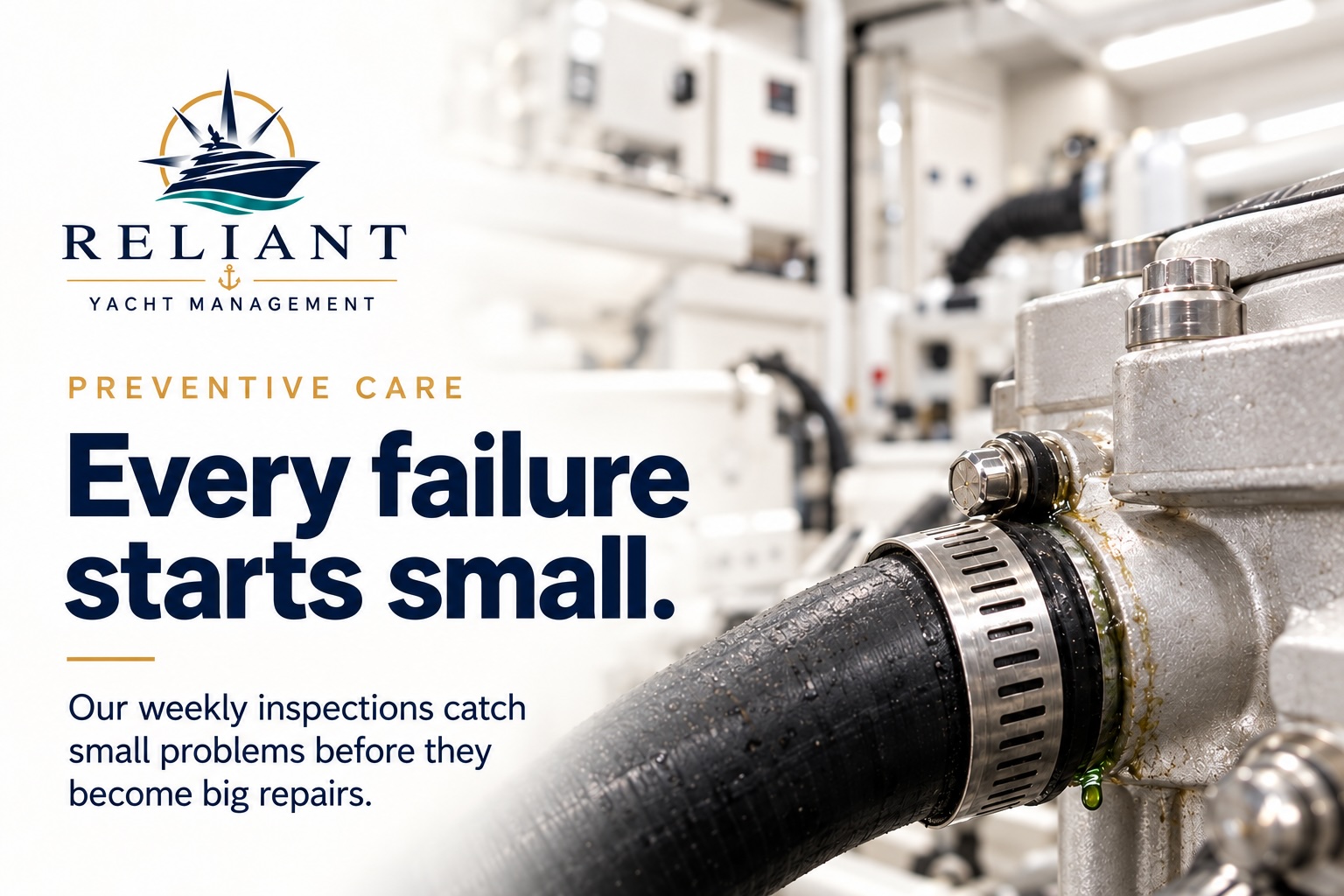
A seep around a raw-water pump or hose connection can deposit seawater on nearby equipment. Repeated wetting can promote corrosion on fasteners and electrical connections. The eventual repair may involve components that had nothing to do with the original leak.
There is also a separate risk to cooling performance. A small seep does not necessarily mean the engine lacks adequate cooling water. But if a deteriorating connection opens further and water delivery falls sufficiently, the engine can overheat. In a wet-exhaust installation, inadequate water flow can also expose exhaust hoses to excessive heat.
Location helps determine priority. A small leak dripping onto an electrical connection deserves different attention from an isolated, dry stain. The size of the visible mark is only part of the assessment.
A loose electrical connection changes under load
Vibration can loosen a poorly secured connection, while moisture and corrosion can compromise electrical contact. Increased resistance at a terminal creates localized heat when current flows. That heat can damage insulation and neighboring components, turning a connection repair into a larger wiring job.
An intermittent fault may be an early clue. Equipment can appear normal during a brief check yet behave differently under sustained load. Qualified testing helps distinguish a connection or supply problem from a fault inside the equipment, reducing the chance of replacing a component while leaving the underlying cause unresolved.
Make observation a decision, not a delay
Staining alone does not establish an active leak. An old deposit may remain after a successful repair. The distinction is between an assessed condition with a follow-up plan and an unresolved concern that keeps being deferred.
A useful record answers a few practical questions:
- Where is the finding, and which equipment is involved?
- What do the dated photographs show, and was the equipment running or idle?
- Is there fresh moisture or a change from the previous inspection?
- Who will evaluate it, and when? What change would bring that evaluation forward?
For an absentee owner, the last question matters as much as the photograph. Someone has to take responsibility for the next step. A new symptom or worsening condition may justify attention before the next scheduled visit.
A repair is not finished at the invoice
An invoice records work billed. Verification addresses a different question: was the source corrected, and does anything nearby still require attention?
At Reliant Yacht Management, we coordinate qualified vendors and verify completed work as part of our oversight. Depending on the repair, that can involve operating checks by the appropriate professional and a follow-up inspection of the affected area. We explain unresolved findings so owners understand what remains to be done and why.
We support that work with Harbor Guardian, the platform we use to organize inspection photographs, vessel information, and reviewed observations. Its practical value is continuity: a finding stays connected to the yacht’s documented condition instead of becoming an isolated photo in a text message. That context supports professional evaluation and clearer recommendations.
Early intervention may still mean a repair. The advantage is addressing a defined fault before it expands the scope of work, with a clearer understanding of what deserves attention now and what can reasonably be monitored.
If you manage your yacht from a distance, talk with us about scheduled inspections and preventive maintenance planning on Florida’s Space Coast or in Southwest Florida.