
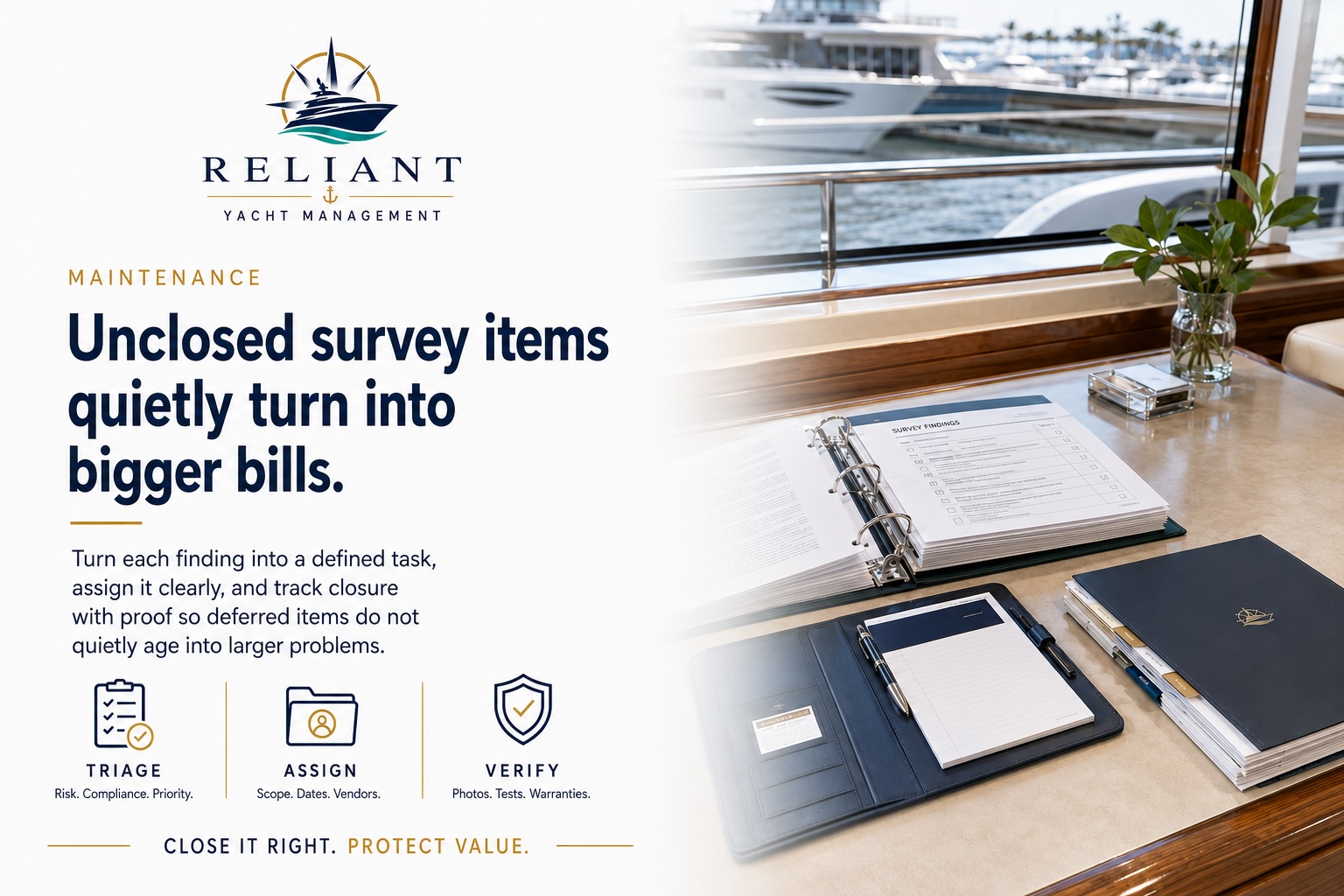
A survey report tells you what a surveyor saw on one day. It doesn’t tell you what to fix first, who’s going to fix it, or how you’ll know the work was done.
For a new owner, that gap matters more than the length of the report. A good survey can list dozens of findings, from a seacock that won’t close to a scuffed canvas enclosure, and it reads like one long worry. The way through is to sort the findings by risk, give each one an owner and a finish line, and keep a record that still makes sense years from now.
Sort by risk before you spend anything
Many surveyors group their recommendations by priority, but the labels vary from one surveyor to the next. Read the reasoning behind each finding, not just the grade. Then put every item into one of three plain groups.
The first is anything that affects safety or keeps her from being used. A through-hull valve that’s seized, chafed wiring near the batteries, a single hose clamp below the waterline where double clamps are expected, a corroded shore-power inlet. These come before any trip.
The second is planned maintenance that gets worse if it waits. Belts and hoses near the end of their life, an impeller that’s due, raw-water strainers that need attention, battery terminals starting to corrode. None of it is an emergency today, and waiting usually costs more.
The third is improvements. Things you’d like, or things a surveyor noted as worth considering. They’re real, but they don’t belong on the same list as the first two.
Sorted this way, you can also spot a quote that bundles optional work in with urgent repairs.
Give every finding someone who owns it
A recommendation in a report is just a sentence. It becomes useful when it turns into a task with enough detail that nobody has to guess. When we manage your boat, each finding from the survey becomes its own task carrying:
- where it is on the boat, with a photo
- how urgent it is, using the groups above
- who’s handling it, whether that’s us, a technician or a yard
- an estimate you’ve seen and approved before the work starts
- what finished looks like, so there’s no argument later
We act as your representative between you and the vendors. We get the estimates, check the scope matches the finding, and keep specialist work with the right specialist. When a surveyor cites an ABYC standard, we pass that wording to the vendor so the fix answers the actual finding. No vendor markups. No hidden fees.
A task closes when the finished work has been checked
This is where punch lists tend to fall apart. A job gets booked, the vendor says it’s done, and nobody looks again. Months later the same item shows up on the next inspection.
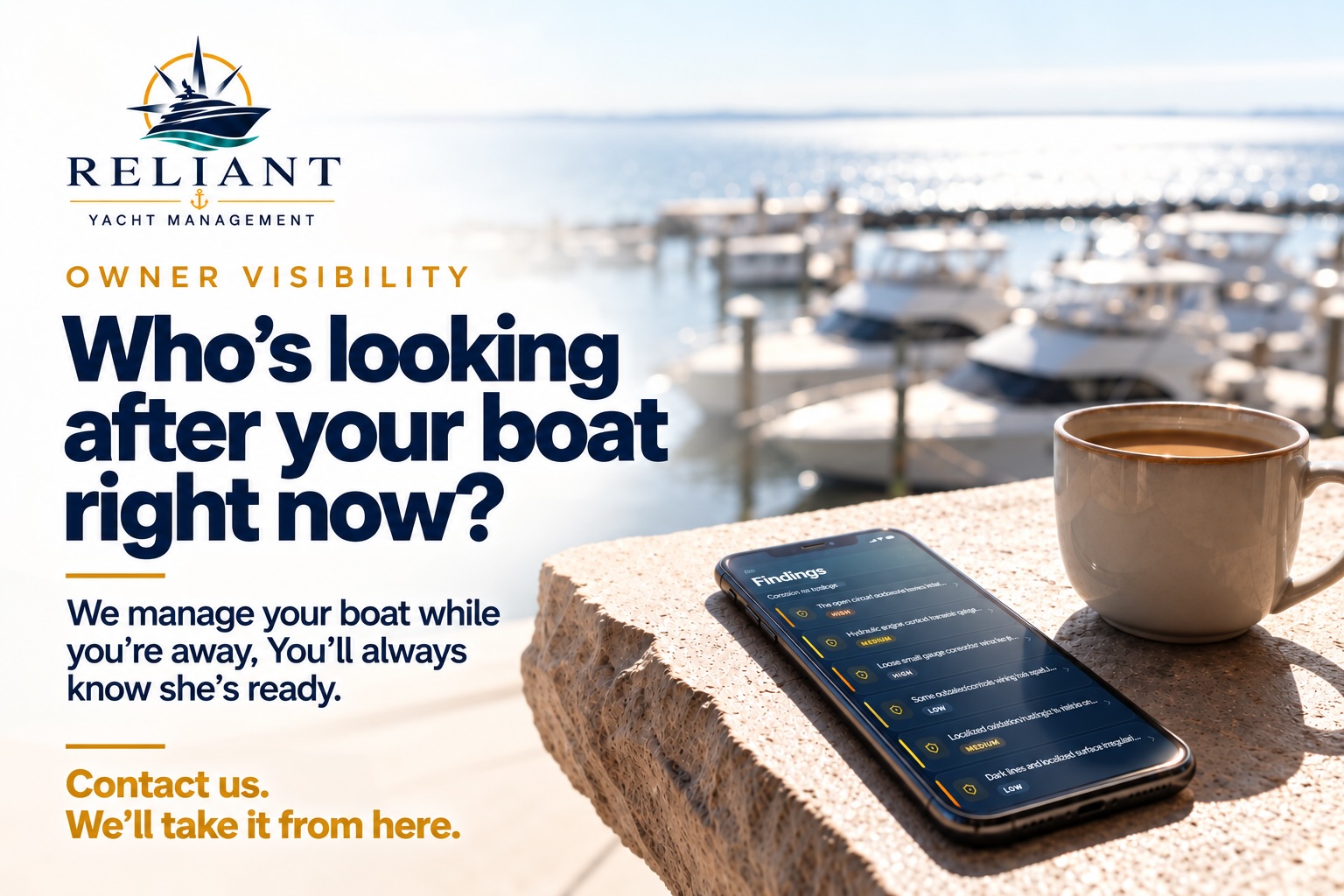
We treat every survey item as open until someone has gone aboard and confirmed the work, with a proof photo of the result next to the original finding. You can see both from your phone, along with who did the job and when. If something was only partly done, the task stays open and you hear about it plainly.
Keep the record a future buyer will ask for
You’re a new owner now, but one day you’ll be the seller. The next buyer’s surveyor will see much of what yours saw, and the question will be what happened to each finding.
A dated service history answers that. It holds each original finding, the estimate, the work done, the vendor and the verified finish, all tied to the boat in Harbor Guardian, the software we use on every boat we manage. The same record helps with your insurer, who may ask you to confirm that certain survey recommendations have been addressed. You send one record instead of piecing it together from emails and receipts.
It also becomes your condition baseline. The survey shows how she was on the day you bought her. The record shows everything since.
Deferred doesn’t mean forgotten
Not every item needs fixing this season, and you don’t have to do it all at once. The risk is in the items you choose to leave. On the Space Coast and in Southwest Florida, heat, humidity and salt air keep working while you wait, and a bit of weeping at a fitting or light corrosion on a terminal can grow while nobody’s looking.
So every deferred item gets a date to look at it again. At each inspection we photograph the same equipment and spaces, and those photos are compared with earlier ones to surface possible changes. A person reviews each flagged change and decides whether it’s the same as last time or worth a closer look. Either way, you’re told what we found and what happens next, and the item moves up the list only when there’s a real reason.
Message us with your boat, where she’s kept and the survey report, and we’ll go through it with you.