

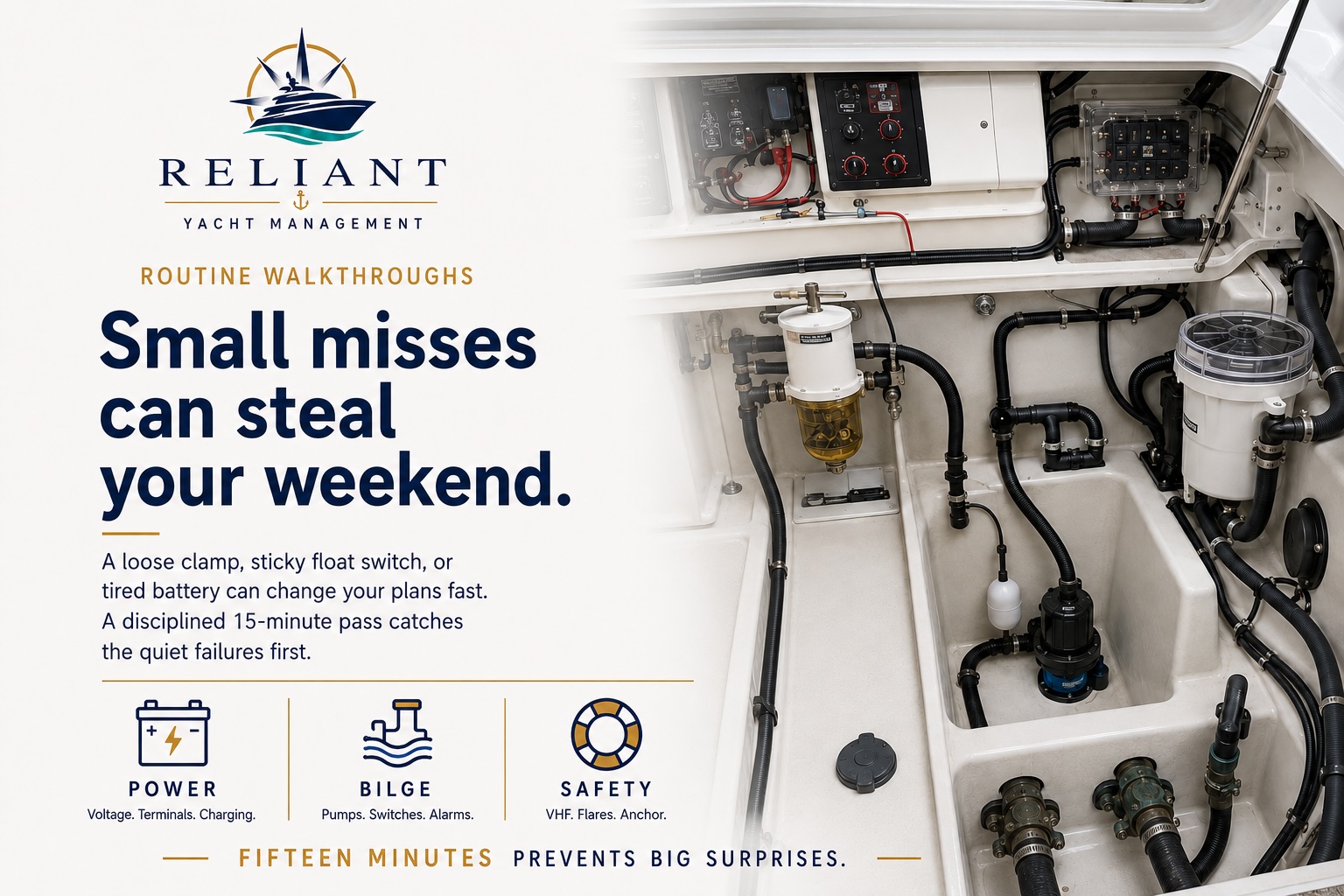
Most walk-throughs end where the eye stops. The canvas is on, the bilge looks dry, the battery switch shows a charge, and the boat seems fine. Those checks are worth doing. They’re also rarely where a cruising weekend goes wrong.
What ends a weekend is usually smaller and quieter: a shore-power plug that’s been running warm, a seacock that won’t close, a strainer half full of growth, a dock line worn through at the chock. None of it shows from the cockpit. All of it can be found in about fifteen minutes if you know where to look. Below is the order we’d walk her, and what to look for at each stop.
Why a quick look misses things
A boat that sits in Florida doesn’t stay the way you left her. Heat and humidity wear on wiring and hoses whether anyone is aboard or not. Marine growth fills raw-water intakes faster in warm water. Lines work against chocks and the rub rail every time a wake comes through.
Most of that happens behind panels, under hatches and in the engine room, so a casual look confirms she’s floating and not much else.
A 15-minute checklist, in the order you’d walk her
At the dock
Start with the shore-power cord and inlet. Look at the plug and the inlet on the boat for discoloration, browning around the pins, melted plastic or green corrosion. Any sign of heat means stop and call a marine electrician. Unplugging it and plugging it back in doesn’t fix anything.
Then walk the dock lines. Check where each one crosses a chock, a cleat or the rub rail, and look for flattened or fuzzed fibers. Chafe gear that has slipped out of position isn’t protecting the line.
On deck
Run a hand along the canvas and enclosures. Look for pooled water, stiff zippers, missing snaps and brittle stitching. A torn enclosure is a nuisance at the dock and a real problem once you’re underway.
Below
Go to the battery bank and look at the terminals, not just the meter. White or green buildup, loose connections and swollen cases all matter. A battery can read fully charged and still be on its way out, so note the charger’s status lights while you’re there.
Next, the seacocks. Work each handle through its range. A handle that hasn’t been turned in months can stick. Look at the hoses and double hose clamps for rust, cracking or weeping at the hull fitting. If a handle won’t move, leave it for a technician rather than forcing it.
Run the air conditioning for a few minutes and check that the condensate drains are flowing. A backed-up drain leaves standing water and mildew aboard a boat that sits closed up.
In the engine room
Look at each raw-water strainer through its bowl. Shells, grass and growth here mean less cooling water reaching the engines and generator. If a cover has to come off, close that strainer’s seacock first. Then look over the belts and hoses for cracks, glazing or soft spots, and check under the engines for fresh fluid. Write down the engine hours so you have a number to compare against next time.
Make the next walk-through easier
Take a photo of each stop from the same angle every time, so you can compare the shore-power inlet or the strainer bowl with last month’s instead of trusting memory. Keep a short note of what you found and what you did about it. When a vendor quotes a repair, that record shows whether the problem is new or has been there all season.
What a walk-through can’t tell you
A walk-through turns up signs, and finding the cause takes a closer look. A brown mark near the inlet, a damp spot under a hose or a belt with a little dust around it might be nothing, or the start of something. Someone has to look closer before anyone knows. Electrical, fuel and through-hull work belongs with the right professional.
What we check when we manage your boat
Our inspections for owners on the Space Coast and in Southwest Florida cover this same ground, done the same way every visit and written down. We check the shore-power inlet, battery terminals, seacocks and double clamps, raw-water strainers, condensate drains, belts and hoses, and dock lines and chafe gear, and we photograph each one. Those photos are compared with earlier ones of the same equipment, and a person reviews each possible change before anything is called a finding.
Findings go into your boat’s record with a photo, location and severity, sorted as urgent, planned or optional. A job stays open until there’s a proof photo of the finished work, and you can see all of it from your phone.
Message us with your boat and where she’s kept, and we’ll set up a first inspection before your next trip.