

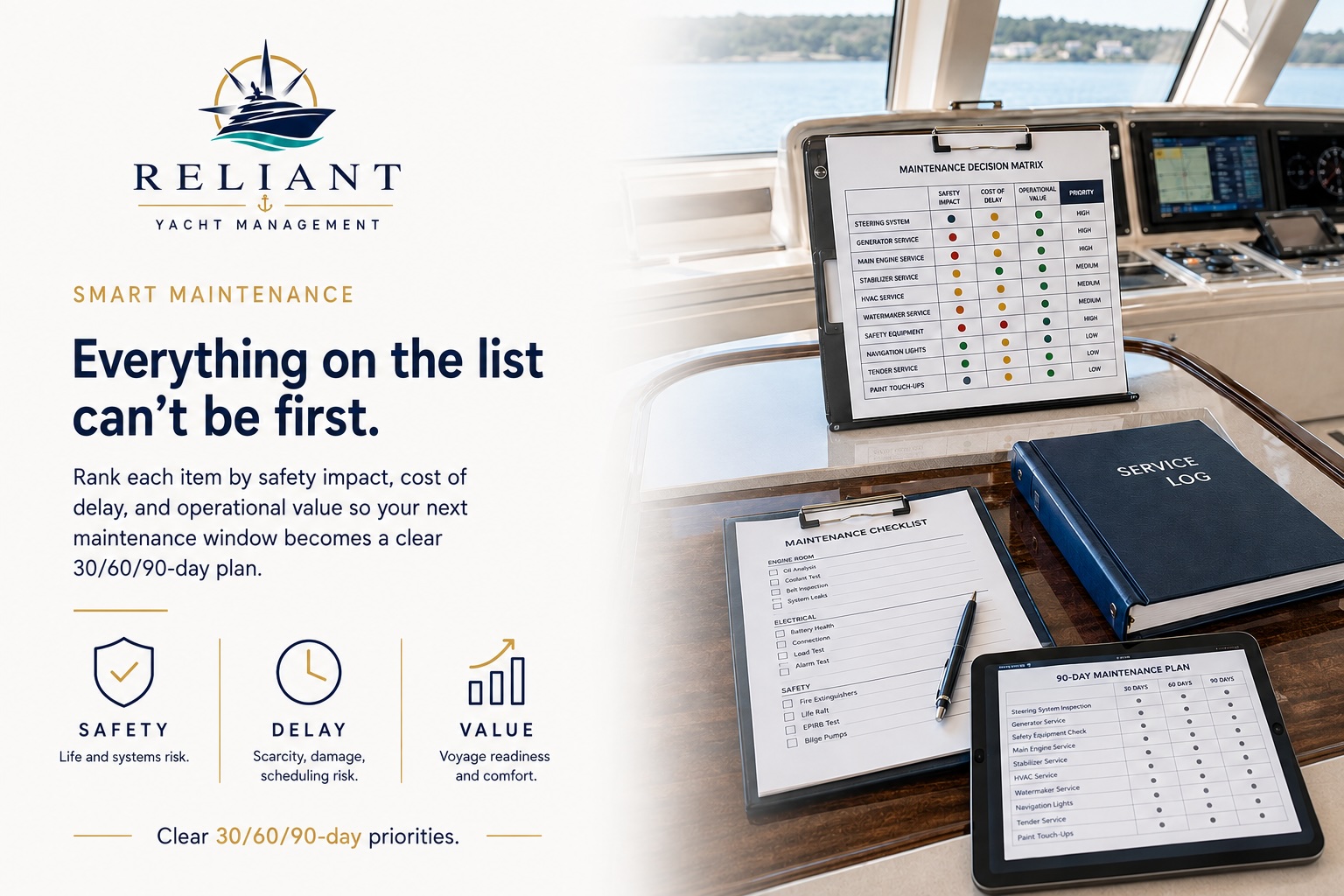
Most maintenance lists are written in the order things were found. The surveyor works from bow to stern, the yard tech works through the engine room, and the list that reaches you reads the same way: a corroded battery terminal, a canvas zipper that’s splitting, a seacock that won’t close, a raw-water strainer packed with growth, an aging stereo. Every line looks equally important because it’s typed in the same font.
That sameness is where the stress comes from. A long list with no order pushes owners toward one of two choices. They fix everything at once and spend more than planned, or they set the whole thing aside until they’re down at the boat. There’s a calmer way. Turn the list into a map by asking three questions of every item: does it affect safety, what does waiting cost, and what does fixing it do for the way you actually use her?
Safety comes first, and it’s usually a short group
Start by pulling out anything that could put people or the boat at risk. That means a seacock that won’t operate, a hose that’s soft or cracked near the hull fitting, a single clamp where there should be two, discoloration or heat marks at the shore-power inlet, corroded battery terminals, or a fuel smell that wasn’t there before. On most lists this is a handful of lines, and they go ahead of everything else.
A finding is a starting point, not a diagnosis. Discoloration at the shore-power inlet needs a proper look, and the answer may be a cleaned connection or something larger. Work on electrical, fuel or gas systems belongs with the right specialist. Our part is getting that person aboard and making sure the job is actually finished.
Then ask what waiting will cost
Some problems hold still. Others grow. A worn impeller or a glazed belt costs little to replace at the dock and a great deal more if it fails underway, when the bill can include a tow and an overheated engine. A little corrosion at a fitting is cheap to deal with early and gets more expensive as it spreads. A canvas seam that’s starting to go lets in more water and sun every week.
Other items can wait with no real penalty: gelcoat scuffs, an electronics upgrade, new cushion fabric. Holding them often saves money, because they can be grouped into a haul-out or yard period instead of each one bringing a vendor down to the dock.
Florida moves some items up the list. Heat, humidity and salt air speed up corrosion and mildew, so a small finding on the Space Coast or in Southwest Florida can turn into a bigger one sooner than it would farther north. Timing matters too. The Atlantic hurricane season officially ends November 30, which makes early winter a natural point to review what the summer left behind and plan work around winter haul-outs. Dock lines, chafe gear and canvas are worth putting on the calendar well before next season.
Weigh what it means for how you use her
The third question is the personal one. An owner who heads out from Port Canaveral every other weekend needs different things than one who flies down to Naples for a few weeks each winter. A generator problem matters a lot if you spend nights aboard and much less if you run day trips. A sluggish windlass matters if you like to anchor out. Air conditioning that struggles looks like a comfort item on paper and becomes a real problem in July.
This is also where honest advice counts. Some items make the boat nicer without changing what she can do. They belong in their own column, clearly labeled, so they don’t compete with repairs.
A sorted list in three groups
Put together, most lists fall into three groups:
- Before she leaves the dock: safety items and anything likely to fail underway.
- This season: items that get more expensive with delay, and anything tied to how you plan to use her next.
- When it makes sense: improvements and cosmetic work, often bundled into a yard period.
The order inside each group comes down to timing and access. If she’s being hauled for bottom work, through-hull and running-gear items move up, since she’s out of the water anyway. If you’re arriving in three weeks, anything that affects that trip moves ahead of work that can wait until spring.
The map will change. A quote may come in lower than expected, or a closer look may show that something minor is more involved.
How we keep the map honest
When we manage your boat, every finding is recorded in Harbor Guardian with a photo, its location aboard and a severity, and a person reviews what the software flags before it becomes a task. Urgent repairs are kept apart from planned maintenance and optional improvements, so you can see the difference from your phone wherever you are. Vendor estimates come to you before you spend, with no markup. Each item stays open until the work is done and verified with a proof photo, so the list you see shows what’s actually finished.
Message us with your boat, where she’s kept and the list you have, and we’ll help you sort out what comes first.