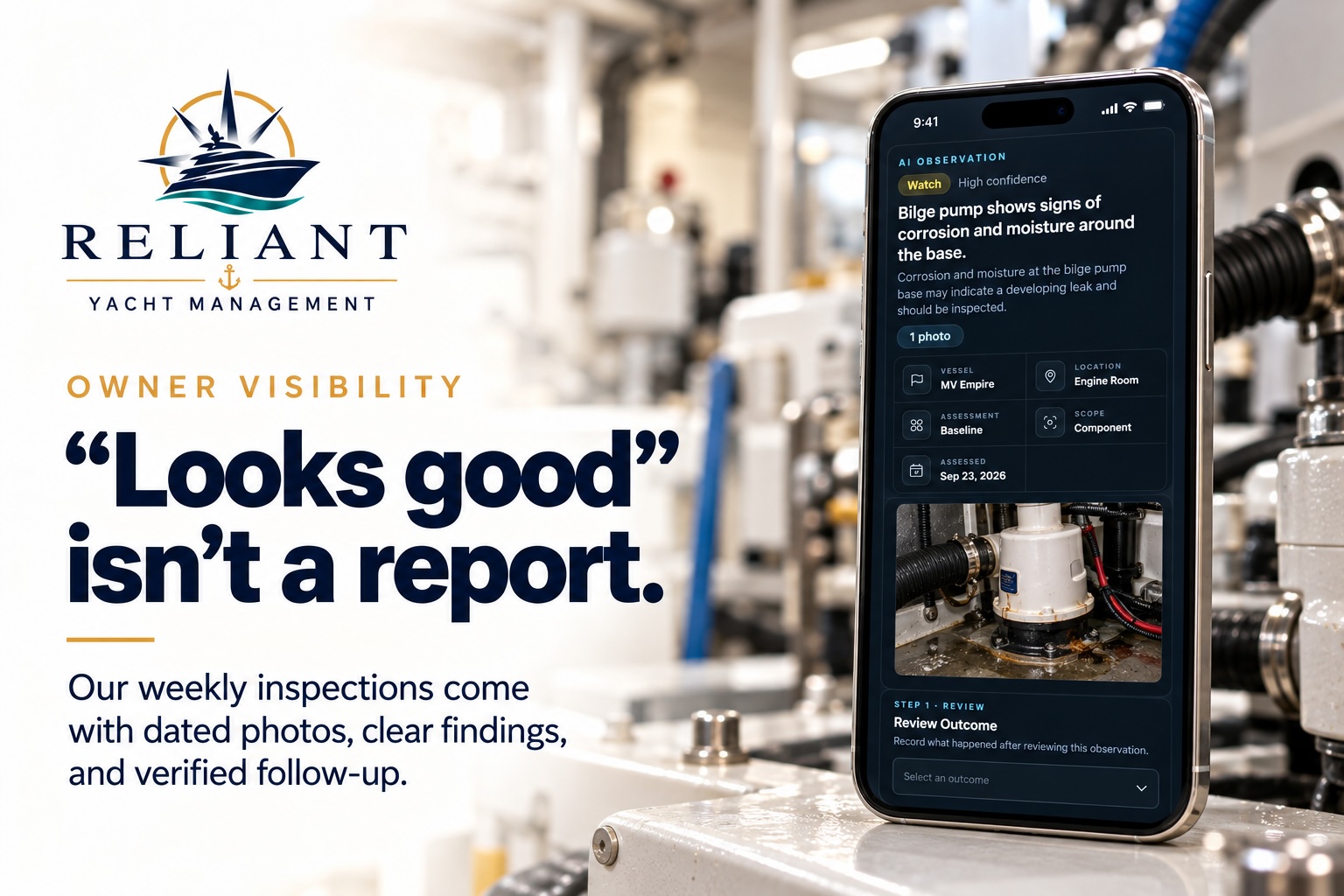
A message saying “the boat looks good” is welcome when you are hundreds of miles away. But it leaves an important question unanswered: what was checked, and what evidence supports that assessment? The same uncertainty applies when a repair update says only “completed.”
Useful visibility lets you trace a recommendation back to an observation and see what happened next. That connection matters more than the length of a report or the number of photographs attached.
Set a clear standard for each inspection
A documented inspection should establish more than the fact that someone visited the vessel. It should record the agreed scope and explain what the findings mean for you. The scope will vary with the yacht and its operating status, but the reporting standard can remain consistent.
Look for these elements:
- The inspection date and the person conducting it, together with the agreed scope of the visit.
- The areas and equipment checked, distinguishing visual observations from functional checks and recorded readings.
- Photographs tied to a location or specific piece of equipment, with enough context to understand what they show.
- Findings separated from possible explanations, followed by a recommended next step and its priority.
- Anything not checked, including the reason it remains unverified.
That distinction between observation and testing matters. A photograph of a bilge pump does not establish that its automatic activation works. An inaccessible compartment cannot reasonably be reported as clear of concerns.
Recommendations also need context. “Further investigation recommended” becomes useful when it identifies the question to resolve and explains whether the concern affects the next outing or can be scheduled for later attention.
Use photographs to understand what changed
A single photograph records a moment. Comparable photographs from successive inspections give a reviewer a better basis for assessing visible change.
Consider a stain beneath a pump. An earlier image may show that the mark was already present, or that its visible extent has increased. That comparison does not confirm an active leak, but it can give a qualified marine professional a more focused question to investigate.
Dates and clear equipment references make these trend photographs useful. Similar angles and lighting reduce ambiguity. A close-up captures detail; a wider view shows where that detail belongs aboard the vessel.
The value comes from a consistent record that someone can review, not simply from taking more pictures.
Keep work visible until it is verified
An inspection finding often leads to service work. Without a record connecting the two, you may know that a vendor attended but still not know whether the original concern was resolved.
A useful service entry identifies the equipment and vendor, with the service date. It preserves the agreed scope alongside what was actually completed, supported by the vendor’s report or other completion evidence. Remaining recommendations stay attached to that work rather than disappearing into a separate conversation.
Completion and verification are different steps. An invoice for replacing a bilge pump documents a charge; it does not, by itself, establish that the installed pump and its automatic activation were checked. The record should identify who performed the appropriate functional check and its result, or explain what remains unverified.
An issue stays open until the evidence supports closing it, rather than closing automatically when the bill is paid.
Give the information an organized home
Scattered records create avoidable uncertainty. A recommendation buried in an email may never reach the next technician. A photograph on one person’s phone may be unavailable when a new finding needs context.
Organizing inspection history alongside service records reduces the chance of missed follow-up or unnecessary repeat investigation. Clear equipment references matter, especially aboard a yacht with several similar pumps. “Pump serviced” leaves far more room for confusion than an entry identifying its location and purpose.
At Reliant Yacht Management, we use Harbor Guardian to keep documented inspections and photographs connected to vessel and equipment information. Its organized record of condition and professionally reviewed observations helps our team retain vessel knowledge and explain recommendations without relying on memory or scattered messages.
We also coordinate qualified vendors and verify completed work as part of our yacht-management services. Those responsibilities turn information into accountable follow-through.
Agree on how updates reach you
The inspection schedule should reflect the vessel’s condition and how it is stored or used. A seasonal owner preparing to return may have different priorities from someone whose yacht will remain idle for several months.
Agree on when routine updates will arrive and which findings warrant prompt contact. Each update should make any required decision clear, including who is responsible for the next step. Before your return, a review of unresolved items helps establish what is ready and what still requires attention.
If your yacht is on Florida’s Space Coast or in Southwest Florida, talk with us about scheduled inspections and ongoing management that keep you informed while you are away.