Seeing Change Over Time: How Consistent Photos and Checkpoints Protect Your Yacht
Most yacht owners don’t lose sleep over a single small leak, a faint stain, or a slightly stiff seacock. The real trouble comes from what those signs turn into when no one notices them changing.
For remote and seasonal owners especially, the challenge is simple: you’re not there often enough to see gradual change. That’s where disciplined, repeat photography and measured checkpoints become one of the most powerful tools in professional yacht management.
Done correctly, they reveal problems you’d miss in real time—and create a visual history you can trust when it’s time to decide what’s next for your yacht.
Why “Snapshots” Aren’t Enough
Many owners receive photos from captains, marinas, or vendors when something goes wrong or a project finishes. Those snapshots are useful, but they’re also:
- Taken from different angles
- Captured in different lighting
- Focused on what’s “interesting” that day
What you don’t get is context.
Without consistent views over time, it’s nearly impossible to answer questions like:
- “Has that corrosion around the thru-hull gotten worse, or does it just look bad in this photo?”
- “Was that rust streak under the windlass there last haul-out?”
- “Is this shaft alignment issue new, or has it been slowly drifting for a year?”
Problems that develop slowly often stay invisible until they’re expensive. A small deck leak becomes core rot. A slightly damp rudder bearing becomes a steering failure. A marginal hose clamp becomes a flooded bilge.
The solution is not more random photos; it’s disciplined, repeatable documentation.
Fixed-Angle Photography: Turning Photos into Evidence
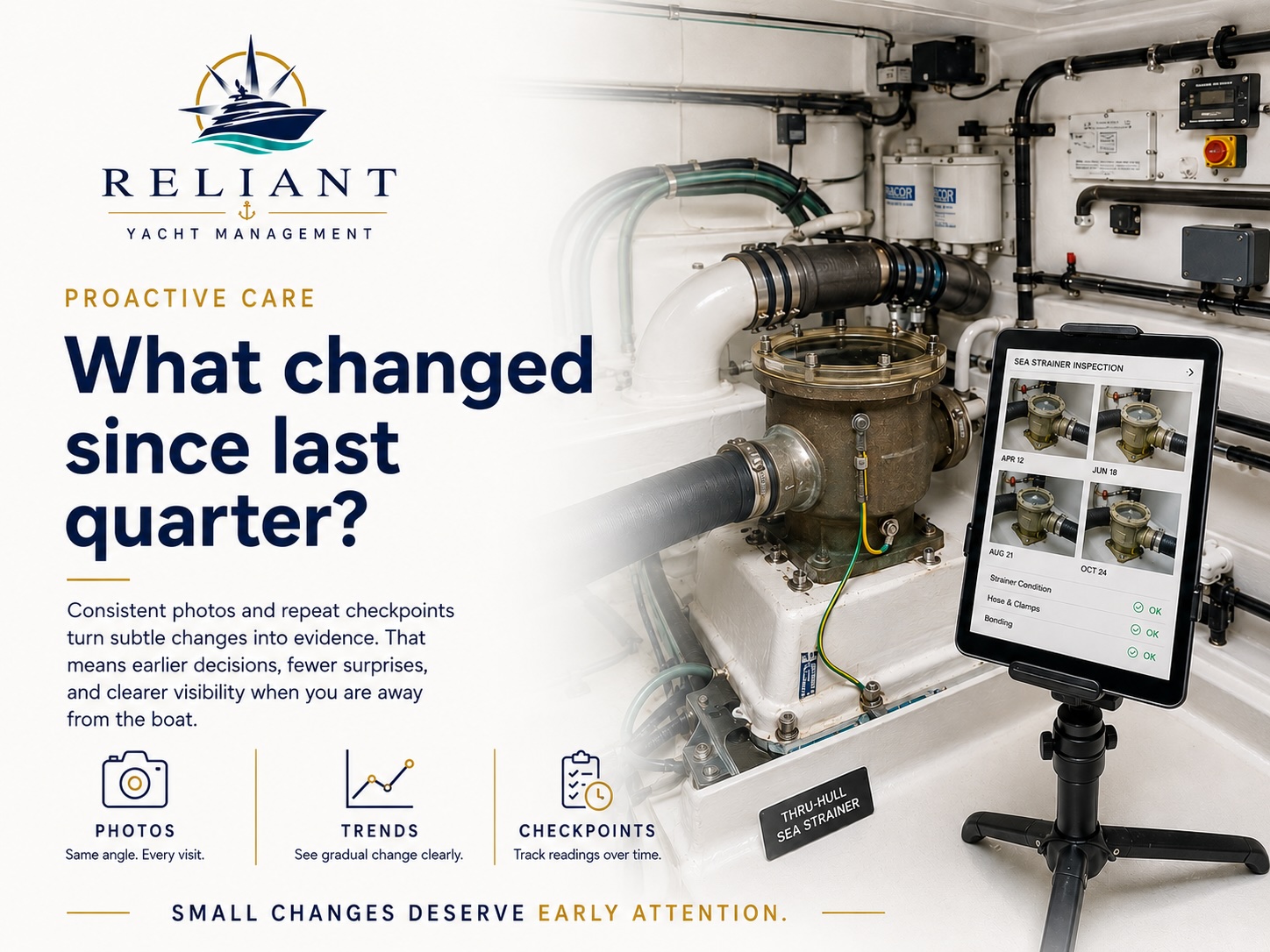
Fixed-angle photography means taking the same photo, from the same spot, of the same component, on a regular schedule. When professional management does this consistently, your photos become evidence—not guesses.
What this looks like in practice
During scheduled inspections, Reliant captures consistent images of:
-
High-risk fittings and penetrations
Thru-hulls, sea strainers, stuffing boxes, shaft seals, exhaust hoses, bilge outlets, and deck fittings. -
Moisture-prone areas
Under deck hardware, around windlasses, window frames, hatches, anchor lockers, and known leak points. -
Wear and movement areas
Engine mounts, shaft couplings, rudder posts, steering components, davits, swim platforms, and passerelles. -
Electrical and safety systems
Battery banks, switch panels, bonding systems, chargers/inverters, and fire suppression systems.
Each visit, the inspector stands in the same position, uses the same angle, and captures a clear, well-lit image. Over months and years, these images become a time-lapse of your yacht’s condition.
What fixed-angle images reveal that a single photo won’t
With side-by-side comparisons, subtle but important changes become obvious:
- A faint rust shadow around a fastener that slowly grows into a visible streak
- Corrosion creeping along a bonding wire or terminal that once looked fine
- A hose that has shifted, chafed, or begun to flatten against a bulkhead
- A seacock handle that becomes progressively harder to move between visits
- Gelcoat cracks or stress lines that lengthen or multiply
For a remote owner, this is the difference between “I hope everything is okay” and “I can clearly see what’s changed since last quarter.”
Measured Checkpoints: Numbers That Tell the Same Story
Photos show what your eyes would see. Measured checkpoints tell you what your instruments would say if you were aboard.
Professional yacht management pairs fixed-angle images with repeatable measurements such as:
-
Bilge condition and water levels
Is there more water than last visit? Is it clear, oily, or discolored? -
Battery health and shore power
Voltage, charge state, charger performance, and evidence of over/under charging. -
Engine room readings
Fluid levels, visible leaks, belt tension, and signs of exhaust staining or heat damage. -
Structural “feel” checks
Movement at rudder posts, play in steering, wobble at rail bases, softness in decks or steps. -
Environmental checks
Interior humidity, odors, signs of mold or mildew beginning in lockers or cabins.
The power lies in consistency. The “one-off” reading matters less than the trend. Gradual increases in bilge water, slowly declining battery health, or progressive softening of a deck area all tell a story if someone is listening.
Why This Matters So Much for Remote and Seasonal Owners
If you’re not regularly aboard, you’re depending on others to notice and communicate change. That’s risky when:
- Marina staff are focused on docks, not your specific boat.
- Vendors see your yacht only when called for a specific issue.
- Photos are taken only when something already looks bad.
Consistent photography and checkpoints, organized into a single record, give you:
- Clear visibility without needing to interpret scattered texts and emails.
- Earlier intervention before issues become disruptive, expensive projects.
- Confidence in recommendations because you can see the progression yourself.
- A defensible record when evaluating vendor performance or warranty claims.
You’re no longer reacting to surprises. You’re making informed decisions with evidence you can review from wherever you are.
Building a Visual History You Can Rely On
A structured, long-term visual record pays dividends well beyond day-to-day maintenance.
Better maintenance and refit decisions
When you can look back through years of images and notes, it’s easier to:
- Prioritize which items genuinely need attention this season
- Decide whether to repair, rebuild, or replace a component
- Justify preventative work based on visible trends, not vague concern
Smoother surveys and resale
A documented visual history can:
- Demonstrate to a buyer or surveyor that the vessel has been consistently inspected
- Show when corrosion, leaks, or wear first appeared and how they were addressed
- Reduce surprises during the survey process and renegotiations
Instead of “trust me, she’s been well cared for,” you can show a clear, chronological record of that care.
How Reliant Uses Technology to Support, Not Replace, Professional Judgment
Reliant’s Vessel Intelligence platform is designed to make this disciplined documentation practical and usable—not to replace captains, surveyors, or mechanics.
Here’s how it supports your oversight:
-
Centralized visual record
Every inspection photo, from the same angles over time, stored in one place with dates, notes, and related work history. -
Organized equipment records
OEM manuals, maintenance requirements, and service history for engines, generators, air conditioning, and other systems linked to what’s visible in your photos. -
AI-assisted review
Technology helps flag potential visual changes—corrosion spreading, staining, leaks, movement—so a professional can investigate further.
The key distinction: AI helps organize and highlight; experienced marine professionals make the final call. Your benefit is a more complete picture with less chance of something subtle being overlooked.
From “I Hope It’s Okay” to “I Know Where Things Stand”
Exceptional yacht management isn’t about how many repairs get coordinated after something fails. It’s about:
- How many problems are prevented
- How clearly you understand your yacht’s condition
- How confidently you step aboard, knowing someone has been looking after it as carefully as you would
Consistent photography, measured checkpoints, and organized documentation turn guesswork into clarity—especially when you’re not nearby.
If you own a yacht on Florida’s Space Coast or in Southwest Florida and want that level of professional care aboard and complete visibility ashore, schedule a conversation with Reliant Yacht Management to discuss a management and inspection program tailored to your vessel.